

Silk is the one thing in my closet that punishes me for being tidy. Fold a scarf into a neat square, stack it in the drawer with the others, and three weeks later it comes out with a crease down the center that will not hang out overnight. A blouse is worse. I wear it four hours, hang it by the collar, and the collar remembers everything. One closet, one long dresser, and I had been losing this fight for years.
I used to handle it badly. Out came the ironing board, a towel over the silk, the iron held an inch above the fabric while I hoped for the best. Twice I left a shine on a scarf that never came out, and one printed square went stiff at the corner and stayed that way. So I asked the Thursday lunch group what they did, and two of them named the same machine without hesitating, the Conair handheld steamer. One said she had bought hers twice, one for the house and one for her daughter in Georgia. I bought one for the dressing room and it has not moved off the dresser since.
The machine that got the ironing board out of my dressing room
Handheld, 1875 watts, and a 7.3-ounce tank that lifts off so you can fill it at the bathroom sink. Forty seconds to heat. I plug it in, fill it, and by the time a blouse is on a hanger the steam is ready.
Amazon Check Today's Price on Amazon →Step 1: Read the Care Label and Test a Corner Nobody Sees
I am not going to tell you that every piece of silk in your closet is safe to steam, because I do not know your silk. Some of it is washable silk off a thrift rack, some of it is a scarf your mother kept in a drawer for forty years, and some of it has a finish on it that I would not put near heat. Read the label first. Then find an inside seam or the back of a hem and give that corner one short pass with the head held a few inches away. Let it dry. If the corner is fine, the rest of the piece will be fine.
A label that says dry clean only is not automatically a no. Half my scarves say it and they have taken steam for years without a problem, because steam is moisture and gentle heat, not the pressing weight of an iron. What I steer around is anything with a stiff hand, anything with a glued hem, and the very old printed squares where the dye sits on top of the fiber instead of in it. When I am unsure I test the corner, and then I stop worrying and get on with it. Two autumns ago I bought a printed square at a thrift store in Plant City and brought it home without testing it, and one pass put a dull patch straight across the middle of the print that never did lift. That scarf now covers my hair when I am pulling weeds. A corner test takes ten seconds and it would have saved me that scarf.
One more thing before you start. Do not steam a stain. Heat sets a stain, and a set stain on silk does not come back out. If a blouse has a mark under the arm or a spot on the cuff, deal with that first and steam it another day.
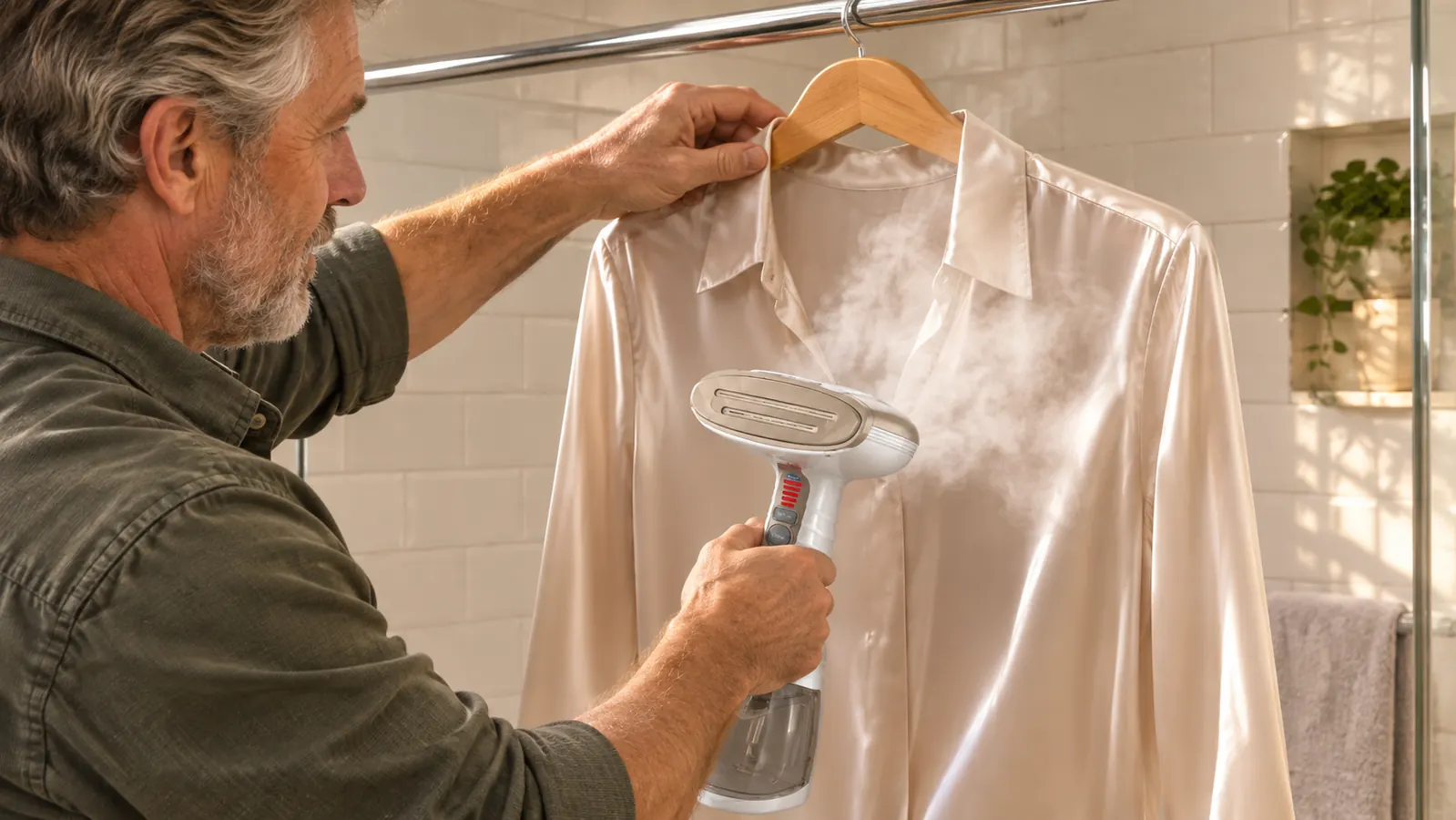
Step 2: Fill the Tank and Give It the Full Forty Seconds
The Conair tank holds 7.3 ounces and comes off the machine. That matters more than it sounds. I carry the tank to the bathroom sink, fill it over the basin where a spill does not matter, and click it back on. I do not have to unplug anything or walk across the room holding a cup. Fill it to the line and no further, because a tank filled past the mark is a tank that spits on your silk, and spitting is exactly the thing you bought this to avoid.
Then wait. The heat time is listed at 40 seconds, and 40 seconds is longer than it feels when you are standing there holding a hanger. I give it the full count and then a few extra seconds of steam into the air, pointed away from anything I care about, just to clear the head. That first burst is always the wettest one. The second one is the one you want on fabric.
A full tank gives up to 20 minutes of continuous steam. In my dressing room that is roughly four blouses and two scarves, working at a pace that is not rushed. It is not a whole closet in one sitting and I have stopped pretending otherwise. I do a batch when the pile on the dresser gets deep, and then I put the machine back where it lives. I learned the tank limit on a Tuesday morning when I was in a hurry for the Thursday group's Christmas lunch, which tells you how far ahead I plan. I filled it past the line, clicked it on, and got a fat wet blot on the front of a blouse that took another ten minutes to dry while Walt asked from the hallway whether we were still going. Fill to the line. The line is there for a reason and the reason ends up on your blouse.
Step 3: Hang the Piece Where It Can Hang Free
The mistake I made for the first month was steaming things still hanging in the closet, pressed up against other clothes. That does nothing at all. The fabric needs air behind it and a little room to move. I use the shower rod in the hall bathroom, or the hook on the back of the dressing room door, or a nail I put in the wall above the dresser years ago for a mirror that never got hung.
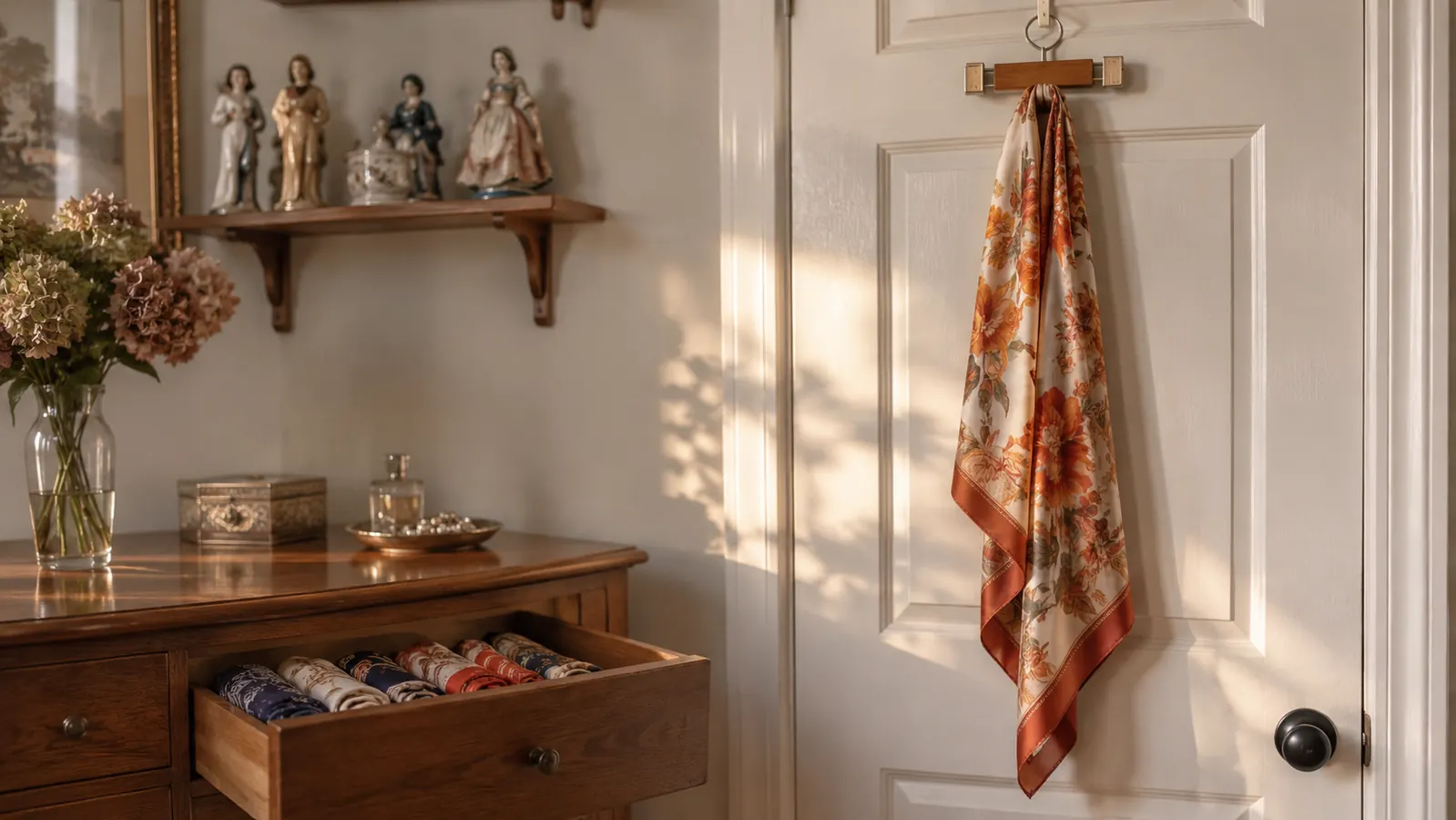
A blouse goes on a hanger with wide shoulders, not a wire one, because a wire hanger leaves a point in the shoulder that no amount of steam will lift. Button it halfway so the front hangs straight. A scarf gets a clip hanger, clipped at one end so it hangs down in a single length, and I put a second clip at the bottom for a little weight. Silk behaves better with a small amount of tension pulling it down.
The cord is 8 feet long, which is more reach than I expected. I can hang a blouse on the shower rod and set the machine on the vanity without hunting for an extension cord. I measured mine one Saturday because I wanted four blouses done before Becca drove over from Tampa, and from the outlet behind the dresser to the shower rod is about six feet of travel with a loop left over. If your only free hanging spot is far from an outlet, measure it before you plan the job and not after, the way I did the first time.
Twenty minutes from a 7.3-ounce tank is four blouses and two scarves, working at a pace that is not rushed. That is the whole reason mine lives on the dresser instead of the back of the closet.
Step 4: Work the Inside First and Keep the Head Moving
The plate on this machine is heated, quilted aluminum, and it does a good job of pressing as it steams. It also means you cannot park it. Keep the head moving in slow, steady strokes and never let the plate rest against the silk, not even for a second, because that is exactly how a shine happens. This is the whole skill and it takes about one blouse to learn.
I start on the inside of a blouse, the side that touches skin, and work down from the shoulder. Then I turn it and do the front on the outside. Silk relaxes from the moisture, so creases drop out from the inside out instead of being flattened from the surface. For a collar or a placket there is a built-in creaser along the plate, and a slow pass with that edge gives a line that looks like it came back from a cleaners.
Three removable attachments come in the box. I will be honest with you: I have tried them and I mostly leave them in the little bag. The bare head handles scarves and blouses, the creaser handles collars, and that is the whole job for me. My other caution is about my own hand. Steam is hot and my hands are not as quick as they were, so I hold the hanger and not the fabric, and I keep the free hand behind my back.
Step 5: Let It Hang a Minute Before It Goes Back
Silk comes off the steamer slightly damp, even when it looks dry. Give it a minute or two on the hanger before it goes into the closet, or you will put a warm damp blouse against six others and wonder later why the whole row smells like a basement. I hang each piece on the back of the door while I do the next one and it takes care of itself.
Scarves get rolled, not folded, when they go back in the drawer. A roll does not make a crease. If a scarf is long and slippery, I roll it around an empty cardboard tube from a paper towel roll and stand it on end in a shallow basket on the shelf, so the rolls do not slump against each other. That one habit has done more for my scarves than any appliance I own. Becca borrowed a long one in March and brought it back folded inside a shopping bag, and I had to steam it and roll it again before it went back in the basket, which I did not mind saying out loud to her.
And then stop. I used to do one piece at a time, whenever I pulled something out, and four minutes of work felt like a nuisance. Six pieces together once a month takes about twenty minutes and everything in the closet is ready at the same time. Batch it and the machine earns its space.
What Else Helps
I use distilled water in mine. Lakeland tap water is fine as far as I know, but distilled leaves nothing behind in the tank, and my machine is two years old and still steaming clean. A gallon jug lives under the sink and lasts me months.
Two other things earned their place. A hook on the wall at shoulder height, so there is always somewhere to hang the next piece. And wide padded hangers, which cost almost nothing and stop the shoulder bumps that steam cannot fix. Once a year I take the Conair to the curtains in the spare room and to the chair by the window, which is honest work it does well and which I did not expect to use it for when I bought it.
What I would tell you before you buy one: it weighs just over a kilogram and the body measures 8 inches by 5.6 inches by 13.6 inches. That is not heavy in the hand for one blouse and it is noticeable by the fourth. It takes up a footprint on a dresser and it will not tuck into a drawer. There is a limited 2 year warranty, which I have not had to use. It is not a quiet machine either, and the steam has to go somewhere, so I crack the bathroom window.
The honest summary is that this is a good tool with a real place in a dressing room, as long as that place is somewhere you can reach without dragging it out of a box. Mine sits on the dresser next to the jewelry tray, and I use it more because of that.
Start with the scarf that has been folded in the drawer since spring
Fill the tank at the sink, give it 40 seconds, and hang the scarf on the shower rod. You will know after one pass whether it has earned the space on your dresser.
Amazon Check Today's Price on Amazon →