

My friend from my Thursday lunch group put the question to me straight: if she could only keep one, the iron or the steamer? I have pressed and steamed a lot of clothes in my life, first on the floor of a department store and now in the spare bedroom I turned into a dressing room, so I gave her the short answer before we got into it. A handheld steamer like the Conair Steamer for Clothes and Upholstery handles anything that hangs, anything delicate, and anything you cannot lay flat on a board. An iron does one thing a steamer cannot do, which is press a real crease. Almost everything else goes to the steamer.
Then we stopped arguing and tested it. She came over on a Saturday with four things: a lined blouse, a pair of linen trousers that had been folded in a drawer since spring, a cotton shirt with a stiff collar, and a silk scarf her mother left her. I got out the Conair, the board, and my old iron. Two hours later she had her answer, and it was not the one she walked in with. The iron earned its keep on one of those four items.
| Conair Handheld Steamer | Standard Steam Iron | |
|---|---|---|
| Heating up | About 40 seconds, then you steam | A few minutes, plus finding the board |
| Garments that hang | Blouses, dresses and jackets, right on the hanger | Has to come off the hanger and onto a board |
| Sharp creases and pleats | The creaser suggests an edge, it does not press one | The only tool that makes a real crease |
| A stack of cotton shirts | Fast for one, tiring by the sixth | The shirt lies flat and the plate does the work |
| Bedding and table linens | Awkward on a hanger | Lay it flat and slide the plate across |
| Curtains and upholstery | Steams them where they hang | You would be taking them down first |
| Buttons, beading, embroidery | Steam goes around the trim | The plate catches on it |
| Storage | 8 by 5.6 by 13.6 inches, sits on a dresser | Needs a board and somewhere to keep both |
| Weight in hand | About 2.3 pounds, used in short bursts | Heavier, and you press down with it |
| Silk and knits | Relaxes the weave without flattening it | A hot plate can scorch or stretch it |
| Warranty | Limited two years | Varies by brand |
What surprised me was which item the iron lost. I expected the cotton shirt to go to the iron and everything else to the steamer, and that is close to what happened. But the hardest piece was the lined blouse, because the lining and the shell slide against each other under a hot plate and you end up pressing a wrinkle into one layer while flattening the other. Held up on a hanger and steamed, both layers let go at once. That is not a brand thing. That is what steam does.
How I Compared Them
I did not do this in a lab. I did it the way I do everything, which is to use both tools on my own clothes for a few weeks and then make my friend do the same so I could watch somebody else struggle with the parts I had already figured out. Same four garments, same afternoon, same outlet. No starch, no pressing cloth, nothing clever.
A word about my bias. I wanted the steamer to win, because I am sixty-four and I have had a board standing open in my dressing room for two years and I resent the space it takes. So I made myself keep score properly. Every garment that came out of the closet got a mark for which tool finished it, and I wrote down the ones that needed both. There were more of those than I expected going in.
The other thing I did was time it, honestly rather than with a stopwatch. Getting the board out, setting it up, filling an iron, waiting for heat, and then putting all of it away is a job of its own before you have touched a single blouse. The steamer lives on the dresser beside the scarves. That difference does not show up in the finish, but it shows up in how often you actually bother.
Where the Conair Steamer Wins
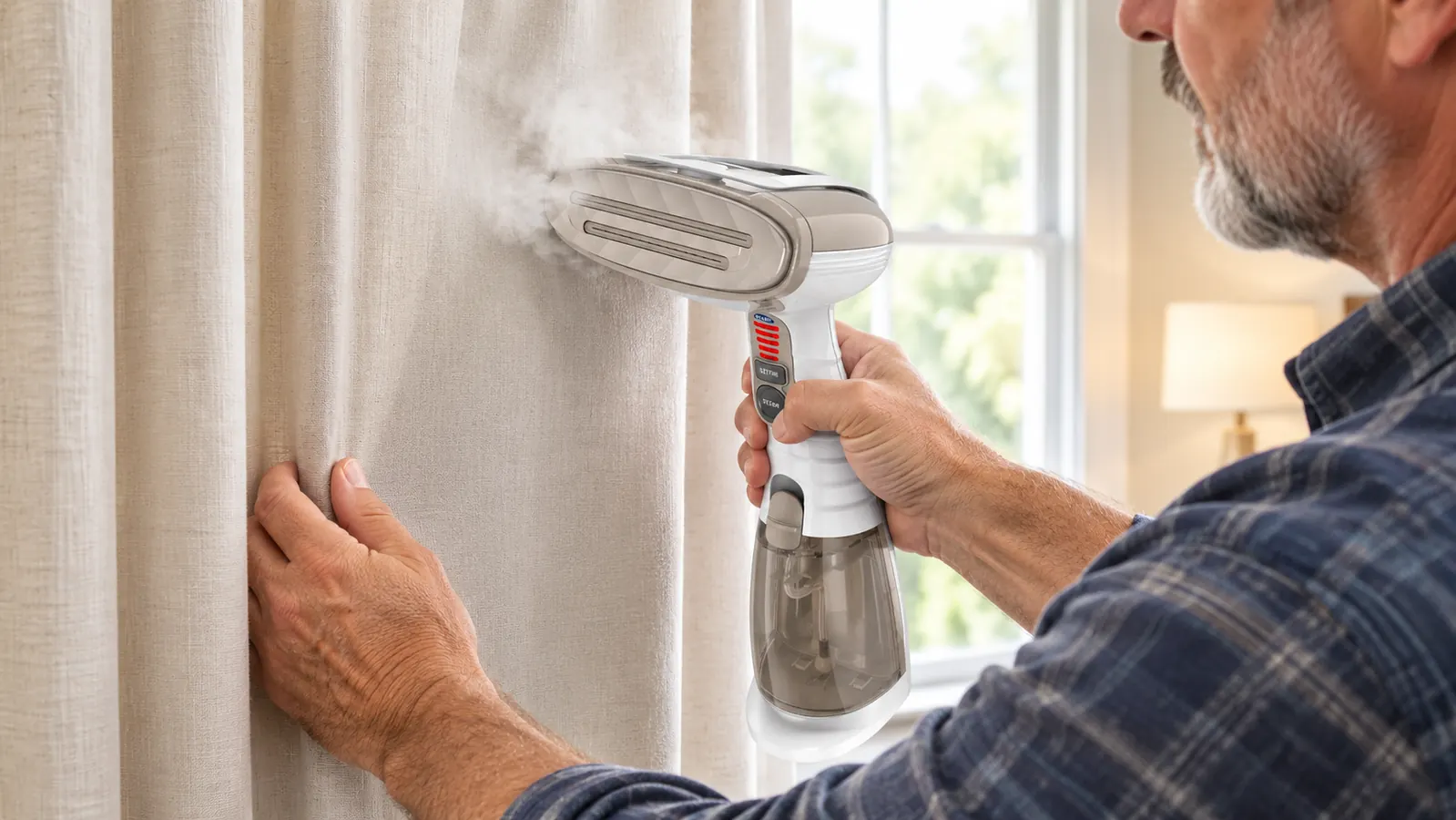
Hanging clothes, full stop. Everything in my dressing room hangs: the scarves on a rail, the brocade jacket I bought at an outlet mall and have never once pressed, the blouses I wear to lunch, the curtains I sewed myself and will not take down again. A steamer works on clothes in the position they already live in. I do not own a board long enough for a curtain panel and I am not buying one now.
The Conair heats in about 40 seconds, and that matters more than it sounds. With the iron I have to set up, fill, wait, test on a towel, and by then I have talked myself out of the whole job. With the steamer I take the blouse off the rail, run it over, and hang it back up. The entire thing takes less time than finding the board would.
The tank holds 7.3 ounces and gives about 20 minutes of continuous steam per fill. Twenty minutes is generous for a blouse and tight for a curtain panel, so the curtains get two fills and everything else gets one. The tank lifts off, which sounds like a small thing until you have carried a hot appliance across a room to the sink to top it up. The listing promises no spitting, leaking, or wet spots, and in my use that has held as long as I do not overfill it.
Three attachments come with it and the one I reach for is the creaser. It is not a pressed pleat and I will say so in a minute, but it puts an edge back into a scarf or a sleeve placket well enough that nobody at lunch looks twice. The heated soleplate and the quilted aluminum plate give it just enough press for a cotton shirt front when I am in a hurry, and the 8-foot cord reaches from the outlet by the door across the whole closet. My iron's cord does not.
The iron came out for one item out of four. The other three went back on the hanger and got steamed where they hung.
It weighs about 2.3 pounds. You use it in short bursts rather than bearing down on a board, and my shoulder notices the difference by the end of a basket. I set it down on the dresser between garments and pick it back up. It is also the only tool in that room I would trust near a beaded evening bag, and I own three of those.
Here is the part that has nothing to do with getting dressed. The blank wall in my dressing room has scarves pinned across it, and they go limp and dusty after a few months. I take one down, steam it over the bathtub for thirty seconds, and it hangs flat again. Same for the fabric backing behind my brooch board. A steamer is the only thing I have found that freshens a display without taking the whole thing apart.
One more, and then I will get to the other side. It does upholstery and curtains, which the listing says and which I did not quite believe until I tried it. The bedroom panels had a crease down the middle from the way they were packed. Four minutes with the steamer and the rod still in place and the crease was gone. The other way is take them down, wash them, press them, and I would still be putting it off.
Where the Iron Wins
Creases. Real ones. If you want a knife edge down the front of a pair of trousers, or a collar that stands up by itself, or a hem that stays folded, an iron is the only thing that will do it. The creaser on the steamer suggests a line. An iron commits to one.
A stack of cotton shirts is the other one. Steaming one shirt is faster than setting up a board. Steaming twelve is tedious, because you are holding the steamer up in the air with one hand and pulling the fabric taut with the other, and by the sixth shirt your arm knows exactly what you have asked of it. With an iron the shirt lies flat and stays flat while you work.
Yardage, too. A tablecloth, a stack of napkins, a bedsheet. Lay it flat, slide the plate across, done. Steaming a bedsheet on a hanger is a comedy routine and I have performed it. Anything that wants to be folded into a crisp rectangle at the end of it is iron work.
And shine, in one narrow case. Dark cotton that has gone shiny at the collar will not be fixed by more heat. A light pass on the inside of the collar with a cloth over it, then a steam over the outside, and the mark softens. That is the only time I use both tools on the same garment, and it does work.
Steam the ninety percent and borrow a board for the rest
1875 watts, a 7.3-ounce removable tank, about 40 seconds to heat and up to 20 minutes of continuous steam per fill. Three attachments, an 8-foot cord, and a limited two-year warranty. This is the one I reach for on a Tuesday morning.
Amazon Check Today's Price on Amazon →
What Annoyed Me About the Steamer
Twenty minutes goes fast when you are doing curtains, and there is no warning before it runs dry. It just stops steaming and you stand there looking at it. I have learned to fill the tank before I start and to keep a jug on the dresser, but the first few times it caught me out and I blamed the machine before I blamed myself.
The attachments are small and they come off easily, which is good until one rolls under the dresser. I keep them in a little dish now. And I do not leave water sitting in the tank between uses, because standing water in anything in a Florida house is asking for trouble. That is my habit, not a rule printed on the box.
One more honest note. It does not press. If you are expecting a steamer to replace an iron entirely, you will be disappointed the first time you want a sharp crease and cannot get one. That is the whole trade. Steam relaxes fabric. An iron flattens it. Those are two different things and no single appliance does both well.
Who Should Buy Which
Buy the Conair steamer if your clothes hang. If your closet is mostly blouses, dresses, scarves, knits and jackets, and you have been avoiding the iron because getting the board out is a production, you will use this four times a week and the iron will end up at the back of the closet. It is also the only sensible choice for curtains, upholstery, and anything beaded or trimmed.
Buy or keep an iron if you wear cotton and linen shirting, if you like a pressed crease, if you press table linens, or if you have a husband like my Walt with four dress shirts and a strong opinion about the collar. Buy the steamer first and borrow an iron until you know how often you actually reach for one. That is what my lunch friend did, and she has not asked for the board back.
If I were starting from nothing in a small house with one closet, I would buy the steamer this month and put the iron on a shelf. Then I would wait a season and see whether I missed it. Most of us will not. The few who do will know exactly why, which is a better place to be than guessing.
Start with the silk scarf. You will not go back to the board.
Take the thing you were always most afraid to iron, hang it up, and give it a minute of steam. That is the whole argument, made in your own dressing room.
Amazon Check Today's Price on Amazon →