
I bought the Conair handheld steamer because a salesclerk at the outlet mall talked me into a linen blouse I had no business owning. You know the blouse. Pretty on the hanger, a crumple machine the second you sit down in it. My iron and I have never been friends, and the idea of dragging out the board on a Tuesday morning before lunch with my old coworkers from the store was more than I was willing to do. So the steamer came home with me instead, and it has been sitting on the dresser in my spare room ever since.
Here is the short version before the long one. It heats up in about 40 seconds. The removable tank holds 7.3 ounces and gives you up to 20 minutes of continuous steam. There are three attachments, a heated soleplate, and a built-in creaser. It also weighs 1.03 kg, which my wrist noticed the first week, and the tank runs dry faster than the box led me to believe. I have used it for months now, on blouses, scarves, trousers and two sets of curtains, and I have a few things to say that the Conair product page does not.
The Quick Verdict
A genuinely useful steamer for blouses, silk scarves and curtains, undone slightly by the weight in your hand and a tank that empties faster than you expect on big jobs.
Amazon Check Today's Price →If your closet is full of blouses that hate the iron, this is the one I kept
Same model sitting on my dresser. It heats in about 40 seconds and handles silk without the nerve-wracking part. Check today's price and the current reviews before you decide.
Amazon Check Today's Price on Amazon →How I've Used It, and What My Routine Looks Like
The steamer lives on the long dresser in my dressing room, next to a bowl of brooches and a stack of scarves I keep meaning to sort. The cord is 8 feet, which matters more than I expected. The only outlet in that room is behind the dresser, and 8 feet gets me from there to the closet door, which is where I hang whatever I am about to steam. I plug it in, hang the blouse on the door handle, and by the time I have found my shoes it is ready to go.
Forty seconds is the number I keep coming back to. My iron takes longer than that to heat, and then there is the board, and the sleeve board, and the whole production of it. With this I steam one blouse and put it on and get on with my morning. On the mornings before the Thursday lunch it is a blouse and a scarf. If the scarf is silk I hold it up by two corners and work down it in slow passes, and it behaves itself.
The first time I used it properly was a Thursday in early March, and I remember because I was in a mood. That linen blouse had been folded in a drawer since the previous August, and when I shook it out it looked like it had been slept in. I set up the iron first, out of habit, got as far as the board and the sleeve board and the little spray bottle, and then thought better of it. The steamer was already warm. Four passes down the front, two down each sleeve, and I hung it back on the door while I put my earrings in. Twenty minutes later it still looked right, which is not something I can say for everything in that closet.
I have also used it on things that are not clothes. The living room curtains, which came out of the package with a fold line down them and kept that fold line for a solid year. The arm of the little chair by the window, after Walt set a damp umbrella against it and forgot all about it. The three attachments that come in the box stay in the little bag they arrived in, and I will be honest with you, one of them has never come out. The other two I use for collars and for the pleat at the back of a blouse.
The routine itself is short. Fill the tank, plug it in, wait, steam, unplug, empty whatever is left. I empty it because standing water in anything sits and goes stale, and I would rather start clean next time. Once you have done it a handful of times the whole thing takes less time than reading this paragraph.
What It Does Well
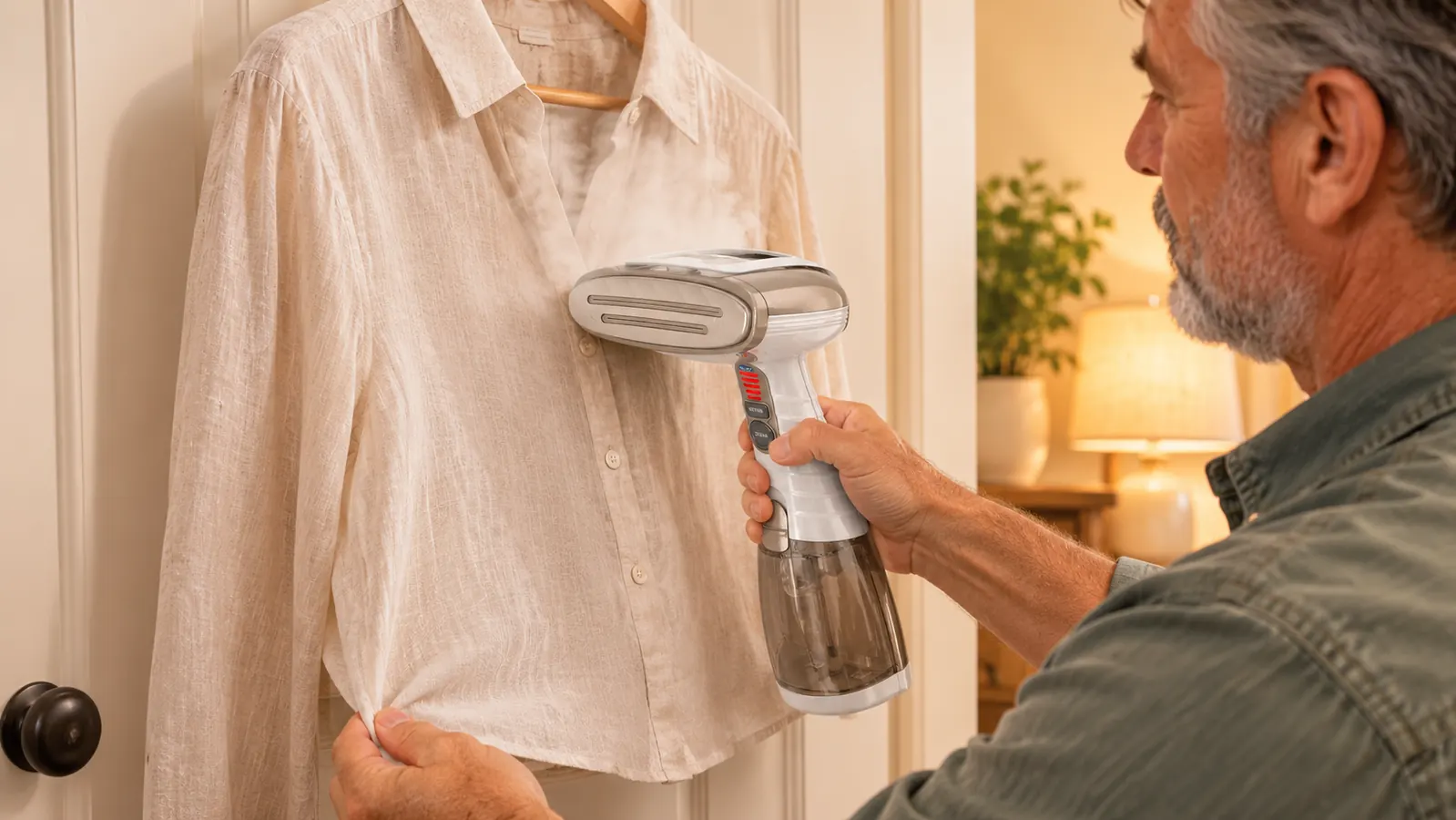
Silk. This is the reason it stays on the dresser. I have four silk scarves I wear in rotation and two of them hold a crease if you look at them wrong. A dry iron on silk makes me nervous, and I have the scorch mark on an old slip to prove it. Steam does not make me nervous. I hold the scarf up, run the head down it, and the crease lets go. Nothing has been ruined yet, and that is the whole review of that feature.
Let me be specific about one scarf, because generalities do nobody any good. It is a long ivory one with a hand-rolled hem, thrifted years ago, and it lives folded in a drawer with three others. Folded is the problem. It comes out with two parallel creases down its length and one across the middle, and they are stubborn. What works is holding it by one corner so it hangs free, and running the head down the length in slow passes from the top toward the floor, letting the weight of the fabric pull the crease out behind the steam. Three passes. Then I fold it in half and it hangs properly again. My iron has never once done that for me, and I have tried.
Everyday cotton and linen. The blouse that started all of this, plus the linen trousers I bought in the same weak moment at the same outlet. The Conair gets the worst of the creasing out in a couple of passes. It is not glassy smooth the way a press would do it, but it is wearable, and wearable is what I am after at seven in the morning.
The heated soleplate and the creaser. This is the part I did not expect to care about and now use constantly. The heated plate gives you a pressed edge, and the built-in creaser does a collar or a center pleat properly instead of approximately. On a cotton blouse with a collar I do the collar with the plate and the body with steam, and it comes out looking like it was done by someone with more patience than I actually have.
Thicker fabrics, which surprised me. A cotton curtain panel, a heavier tunic, a lined cotton jacket that only needed the sleeve smoothed. It takes more passes and more time, but the power is there and it does not fade out halfway through the panel the way a smaller handheld might.
Forty seconds from cold to steam. That is the whole reason this stays on my dresser: by the time I find my shoes, the crease is already gone.
What Nobody Tells You Before You Buy
Twenty minutes of continuous steam sounds generous. It is not generous if you are doing a curtain. The tank holds 7.3 ounces, and on a single blouse I use maybe a third of it, which is fine. On the living room curtains I refilled twice and was not happy about it. The tank comes off and goes back on without a fight, and thank goodness, because you will be taking it off more often than the description suggests. For the record, the living room has three panels. I refilled once after the second panel and once partway through the third, and the whole job took most of an afternoon because I kept stopping to let my arm rest.
It has real weight in the hand. The listing says 1.03 kg, and 1.03 kg does not sound like anything at all until you are holding it above your head to reach a curtain rod. For a blouse on a hanger at chest height it is perfectly fine. For a long session my forearm lets me know, so I switch hands, or I rest my elbow on the dresser and steam from there, which looks ridiculous and works beautifully.
Where you plug it in matters more than you would think. The 8-foot cord is generous for a handheld, but this is still a corded appliance. You need an outlet near the place where you hang things. In my dressing room the outlet is behind the dresser, and the cord reaches the closet door with about a foot to spare, which is lucky. I measured it one afternoon with a tape, because I am that person now. From the outlet, around the back of the dresser and across to the door handle, is a hair over seven feet. One foot of slack, and you cannot shorten the cord or stretch it. Take a tape measure to your own closet before you order. It takes two minutes and saves an argument with yourself later.
The machine is 13.6 inches tall and 8 inches long, which is worth knowing before it arrives. It sits at the back of the dresser top without crowding the bowl of brooches, and it stands up on its own between uses. It is not a small thing you can tuck in a drawer. It wants a permanent home, and if you do not have one picked out, it will end up on a kitchen chair for a month the way mine nearly did.
And it will not replace a dry cleaner. I said what I said. A blazer with a real set to the shoulder, a pleated skirt with a hard press, anything with structure, still goes out. What the steamer replaces is the ten minute ironing board session on things that only needed to be de-crumpled. That is most of my closet, but it is not all of it, and anyone who tells you otherwise has not tried it on a wool blazer.
What I Liked
- Heats in about 40 seconds, so it beats setting up an iron on a work morning
- Silk scarves come out smooth without the scorching risk of a dry iron
- The heated soleplate and built-in creaser give a proper edge on collars and pleats
- The 7.3 ounce tank comes off and refills easily
- The 8-foot cord reaches from the outlet behind my dresser to the closet door
- Handles curtains and thicker fabrics, not just shirts
Where It Falls Short
- 1.03 kg in the hand gets heavy on curtains and long sessions
- 20 minutes of continuous steam goes fast on big jobs, so you refill mid-task
- It gurgles and sighs while it works, which took some getting used to
- It does not replace a real press for structured jackets or pleated skirts
- The tank is small enough that I check the water before every big job
The Parts That Annoyed Me
The water, and how much of it there is. Not the tank itself, which comes off and goes back on without a struggle. The amount. I have learned to fill it before I start rather than halfway through, because stopping to refill while I am already wearing the blouse is a small irritation that compounds into a sour mood.
The sound. It is not loud, exactly, but it is not quiet either. It makes a wet, throaty gurgle that I did not expect the first time I switched it on, and I stood there for a second wondering if something was wrong. Nothing was wrong. I have gotten used to it. Walt has not, and he has opinions about me steaming things while he is trying to watch the news.
The sound, continued, because this is the honest part. Walt watches the news at six thirty and the dressing room shares a wall with the living room, so I have learned to steam earlier in the day or to close the door between us. That is not a complaint about the machine exactly. It is a fact about a small house and a corded appliance that has to live somewhere. If you have a laundry room or a closed-off corner, you will never think about it. If your dressing room is a spare bedroom next to the television, you will think about it every evening.
The setting down problem. There is a heated soleplate, which means when you pause mid-job you want to put it somewhere sensible rather than face down on a dresser with a good finish on it. I keep a folded towel next to it now. It is a small thing. It is also a thing nobody mentions in the reviews I read before I bought mine. The towel is a plain white one folded in quarters, and it lives on the corner of the dresser beside the brooches. When I finish I rest the head on it and pull the plug, and by the time the blouse is away it is cool enough to put in the cupboard.
The creaser has a learning curve. The first time I used it I leaned on it too hard and left a shine on a cotton collar that I had to work back out with steam. The second time I let the plate do the work instead of my shoulder, and it was perfect. If you are the kind of person who presses hard when a thing is not working, start gentle.
What My Thursday Lunch Friends Said
I brought it up over lunch, because that is what I do. One of my Thursday lunch friends has a different brand and said hers spits water onto the fabric, which she demonstrated with a napkin and a gesture that made everyone at the table laugh. I have not had that with the Conair, and I said so, and then I told her honestly about the refills on the curtains so she would not think I was selling her something.
Another one asked whether it would handle her mother's heavy drapes. I said it would, with patience and two refills, and that she should not expect it to be quick. Becca borrowed it for a wedding in Tampa, brought it back with the tank bone dry, and told me it did a dress in four minutes flat. That is the whole word of mouth on it from this house and my lunch table: good, not magic, and it will empty itself if you let it.
Who This Is For
If your closet is mostly blouses, scarves, lightweight trousers and dresses, and your iron lives in a cupboard because you dread it, this is the tool that will actually come out and get used. If you have a spare room, a corner, or a closet door near an outlet where you can hang a hanger for two minutes, even better. It suits someone who wants a blouse to look right in under two minutes and does not need couture-level pressing. It also suits anyone with a stack of silk that has been sitting unworn because the creases scared them.
Who Should Skip It
Skip it if you wear structured jackets, pleated skirts, or heavy cotton shirting that genuinely needs a hard press. Skip it if the nearest outlet is a long walk from where you hang your clothes, because a cord is still a cord and 8 feet is not a hallway. Skip it if you have wrist or shoulder trouble, since 1.03 kg held away from your body stops being a small number fairly quickly. And skip it if you want one appliance to do everything in the house, because this one does clothes and curtains and not a great deal else.
The one I would buy again, annoyances and all
Two honest complaints, one very good reason to keep it: 40 seconds to steam and silk that comes out smooth. Check today's price and see whether the current listing still matches what I described.
Amazon Check Today's Price on Amazon →