
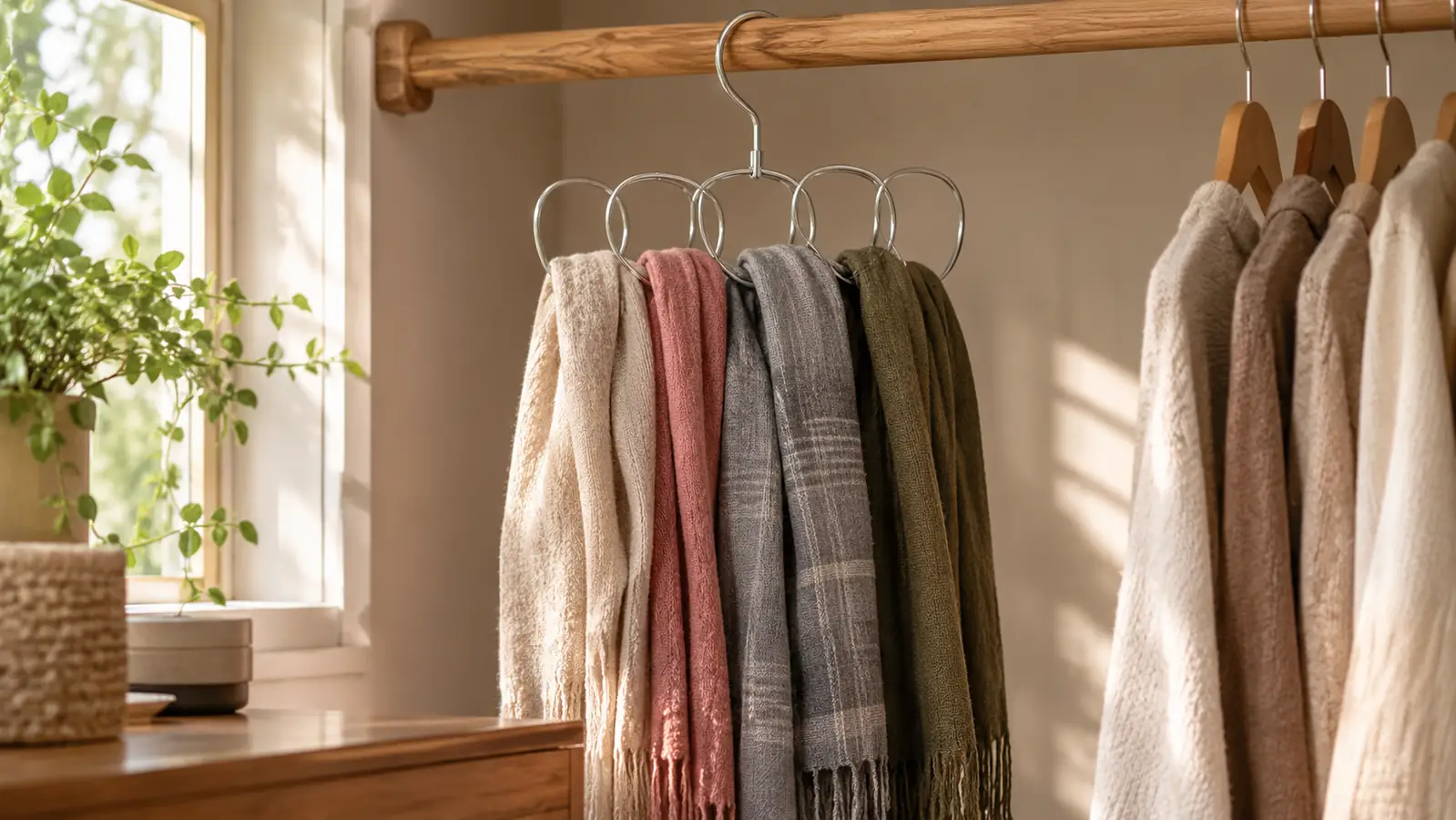
My scarves used to live in the bottom drawer of the long dresser in my dressing room. Folded, stacked, out of sight. Every morning I would pull that drawer open and dig through the pile like I was hunting for a receipt. The silky ones slid out and landed on the floor. The wool ones came out with a crease down the middle that never did come out. And the long printed one my daughter Becca brought me from Tampa was always, without fail, at the very bottom.
One Thursday at lunch, a friend from my old counter job mentioned she had quit drawers altogether and hung her scarves instead. I ordered the Deco Brothers scarf hanger for the closet, the one with 23 loops, and it fixed a small but genuine annoyance in my mornings. What follows is the five-step version of how I set it up, including the two mistakes I made the first week so you can skip them.
The 23-loop hanger that got my scarves out of the drawer
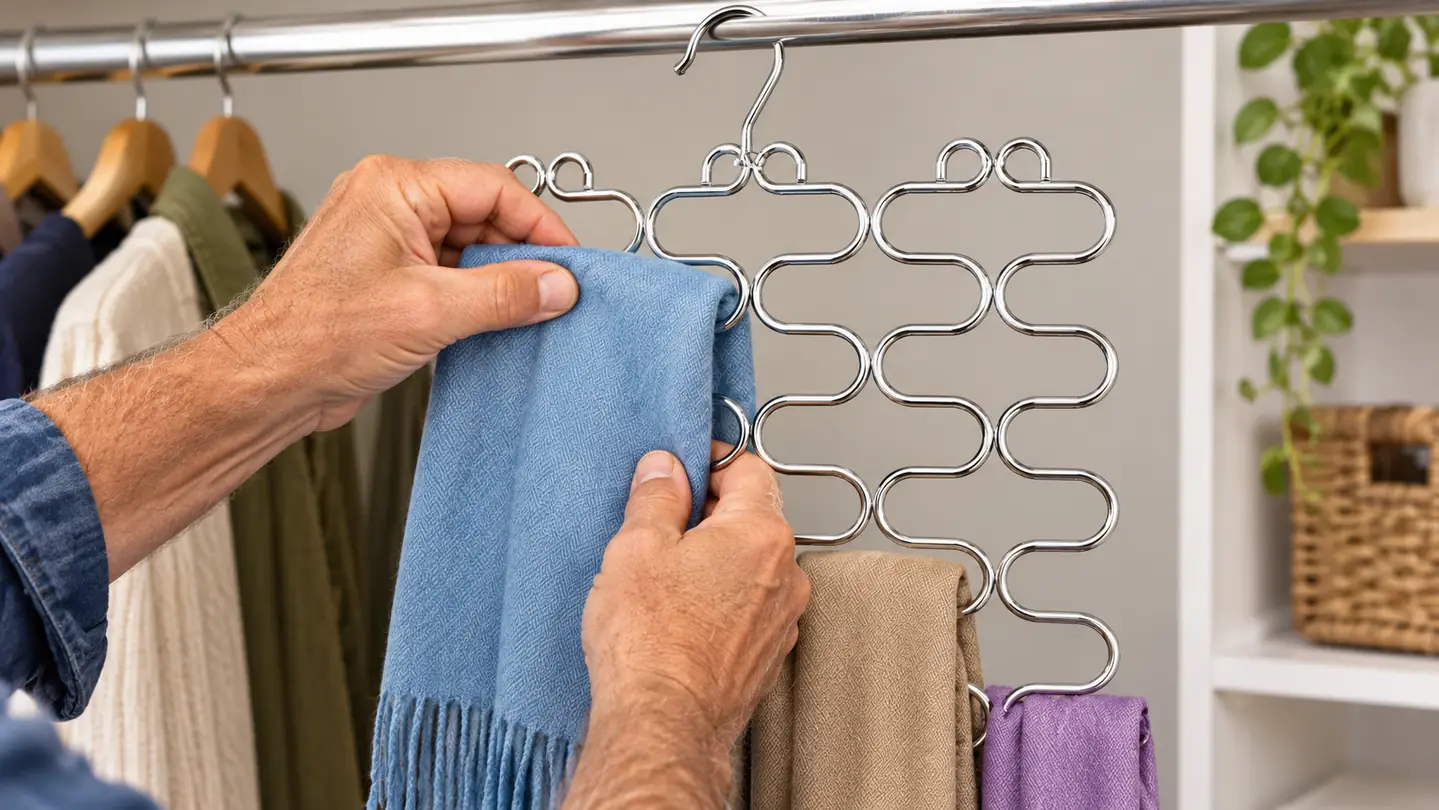
Metal frame, 16.75 inches high and 13.1 inches wide, sized for a normal closet rod and built for scarves, belts and ties. Today's price is on the listing.
Amazon Check Today's Price on Amazon →Step 1: Pull every scarf out and put them in one place
This looks like busywork and it is not. You cannot sort scarves you have not looked at in a year. I emptied the whole drawer onto the bed in the spare room, and I do mean the whole drawer, including the ones I kept telling myself I wore. Halfway through I found three I did not remember owning and one I had clearly bought twice.
Sort as you go, but loosely. Make three piles on the bed: the ones you wore this winter, the ones that belong to a particular coat or occasion, and the ones you have not touched since you bought them. Do not agonize over the third pile yet. Just get it separated from the rest so you can see how much of your drawer was actually dead weight.
While everything is flat, look at the hems. A pulled thread or a small stain is much easier to spot laid out on a bed than bunched in a drawer, and I would rather find it now than in a parking lot. Anything that needs mending goes in a fourth, smaller pile that lives somewhere other than the closet until it is fixed. Otherwise it goes straight back in and you will be doing this again in six months.
Give yourself a real block of time for this part, not five minutes between other jobs. Mine took a Tuesday morning, from about nine until a quarter past eleven, and most of that was deciding rather than moving. I had a second cup of coffee halfway through and I am glad I did, because the sorting is the part that decides whether the rest of this works. If you rush the pull-out, you will hang whatever is nearest and be back in the drawer by March. Lay a towel on the bed first if the scarves are silk, since a bedspread with any texture will catch a loose thread as you slide things across it. And keep a grocery bag on the floor for the donate pile so it leaves the room instead of sitting on the chair for a month.
Step 2: Decide what earns a place before you hang anything
The hanger holds 23 items. That is a real number and not a marketing one, so use it. I had 31 scarves on that bed and 23 loops to fill, which meant eight had to go somewhere else. Knowing the number up front saved me from hanging the first 23 I picked up and then standing there holding the rest.
The eight that came off the shortlist were mostly the ones from the third pile, the untouched ones. I set aside four to donate and four to go in the cedar box for the season, because the wool ones here in Lakeland get about three weeks of use a year. If you live somewhere with a real winter, flip that math. Hang the wool and box the linen.
Do not forget that the hanger is listed for belts and ties as well. I gave four loops to my belts and one to a long necklace I never know where to put, and I still had room for 18 scarves. That is the honest version of how the 23 breaks down in a real closet, not a showroom one.
I did this part sitting on the edge of the bed with the scarves beside me, and I sorted by what I actually reach for rather than by color. That was deliberate. A closet sorted by color looks lovely in a photograph and does nothing for me at seven in the morning, because I am not thinking in colors, I am thinking about what goes with the gray coat. So the four I wear with that coat went to the loops near the top, my two summer-weight ones went toward the bottom, and the rest filled in between. If you sort by color and it works for you, fine, but be honest about which way your hand actually moves. Walt asked me why the scarves were not in rainbow order and I told him they were in Tuesday order, which is a better system.
Step 3: Hang it where the loops are at eye level
The frame measures 16.75 inches tall and 13.1 inches wide. That height matters. My closet rod sits fairly high, and if I had clipped the hanger at the far end of the rod, the bottom loops would have been up around my forehead and I would have been reaching over my head every morning. Hanging it toward the middle, where the rod is at a comfortable height, put the top loops right at my eyeline.
Leave breathing room on both sides. The loops splay out and a scarf needs to be able to slide in and out without dragging five others with it. I pushed a coat over and cleared about a forearm's width, and that was all it needed.
This is where I made my first mistake. I hung the Deco Brothers hanger at the very front of the rod because it was closest to the door, then discovered the closet door would not shut. It is 13.1 inches wide, which is wider than a dress hanger, and it needs to sit perpendicular to the wall. Move it back a few inches and the door closes fine. Five minutes of mild cursing I could have skipped.
Before you commit to a spot, hold the empty hanger up on the rod and stand where you actually stand to get dressed. That sounds fussy and it takes ten seconds. I did it the second time, after the door incident, and picked a place about a hand's width behind the coat I wear most, which turned out to be exactly right. A closet rod is not a uniform thing either. Mine sags about an inch in the middle after twenty-some years of coats, so the middle position also happens to be the lowest point, which helped. If your rod is high and you are short, hang toward the sag. If your rod is low, the opposite.
Twenty-three loops reads like a marketing number until you count your own scarves and land on nineteen. Then it reads like a plan.
Step 4: Fold before you loop, so nothing slips off
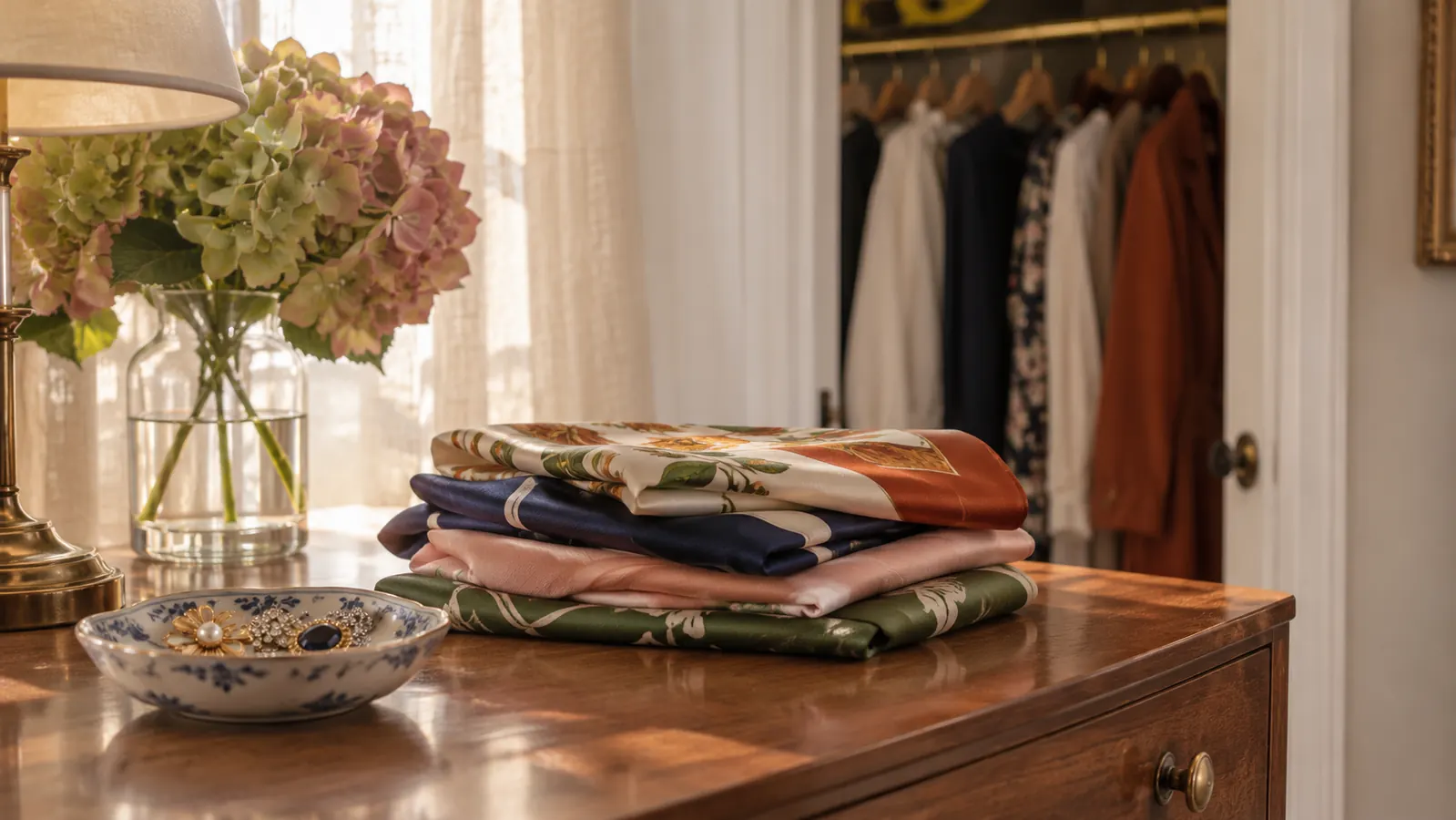
A long scarf dropped over a loop will slide. Every time. Silk is worse. The fix is folding, not knotting. I fold a long scarf in half lengthwise, then in half again, and thread the folded bundle through the loop so the two ends hang down on the same side. The fold takes the weight and the scarf stays put.
Short square scarves get a single fold and their own loop, one each. Do not double them up. Two scarves on one loop means the one you want is behind the one you do not, and you are back to digging in a drawer, just vertically.
Loosely rolled is another option for the heavier woven ones. Roll from one corner, set the roll on the loop, let it settle. It takes up a little more room but it keeps a stiff fabric from creasing along a hard fold line. I do this with the two heaviest ones and hang the rest folded.
Knotting is the thing to avoid, and I know because I tried it. My first week I knotted a slippery printed scarf around a loop to keep it from sliding, and by the third morning it had a soft crease set into it right where the knot sat. It did not come out with steaming, either. A fold leaves a line you can press out in a minute. A knot leaves a memory. Same rule for the woven sashes that come with dresses. Fold them, do not tie them, and never leave one knotted overnight thinking you will untie it in the morning, because you will not.
Step 5: Keep the load light and spread the weight
The listing gives a maximum weight of 16 ounces. That is a pound, total, for everything on the hanger. It is metal and it is sturdier than it looks, but a pound is a pound and I would not test it with a stack of heavy beaded belts on one side.
My second mistake was clipping all six of my belts onto the two loops nearest the top, then wondering why the whole thing hung at a slight tilt. Spread the heavy items out, one heavy to four or five light. I now have belts on loops spaced across the middle and the frame hangs level.
Once a season, take the whole hanger down and look at what is on it. Anything you passed over all season comes off. That one habit is the difference between a system and a shelf that fills up. Mine gets a check in April and again in October, usually with a cup of coffee and the radio on, and it takes about ten minutes.
One more small thing about the load. Silk scarves weigh almost nothing, so 18 of them plus four belts and a necklace is nowhere near that 16 ounces, and I stopped worrying about it once I had actually handled the thing full. The weight limit is really a warning about concentration, not about quantity. A single heavy beaded belt on one outer loop carries more than a dozen silk squares. Keep the heavy pieces near the middle where the frame is strongest and the light ones out toward the ends, and you will never think about the limit again. I have not weighed anything. I just pick it up by the top now and then and see whether it swings straight.
What Else Helps
The hanger solved the hanging problem and left two smaller ones. The first was the scarves that did not earn a loop. Those went into a shallow drawer with a divider, folded flat and filed upright like cards, so I can see the edge of each one. The second was the belts I rotate most. Two of them now live on a hook inside the closet door because I reach for them four days a week and there is no sense making myself unhook them.
Light matters more than I expected. My dressing room has one ceiling fixture and it throws a shadow straight down the closet, so I added a small battery lamp on the shelf above the rod. It is not decorative, it is so I can tell navy from black at seven in the morning. If your closet is dark, that fifteen minutes of setup is worth more than any organizer.
One more thing, and it is the least popular advice I give. Give the Deco Brothers hanger the prime spot on the rod and let the coats move. If the scarf hanger is jammed in a corner behind a bathrobe, you will not use it, no matter how well it is organized. The whole point is that you can see what you own. Put it where you get dressed, not where there happens to be space.
If you want the longer version of how it has held up over months of daily use, there is a full write-up on the site, and a separate piece comparing this to folding everything flat in a drawer. Both are worth five minutes before you decide which way to go.
Still digging through a drawer every morning?
23 loops, metal frame, 16.75 inches high and 13.1 inches wide. Scarves, belts and ties, with a listed maximum of 16 ounces. Today's price is on the listing.
Amazon Check Today's Price on Amazon →