
Here is the short answer, and then I will show you my working. Folding scarves into a drawer is not wrong. It is just slow, and it hides things. The Deco Brothers scarf hanger does the opposite. It puts 23 scarves, belts and ties out in the open where you can see every one of them, in a footprint of about 16.75 inches tall by 13.1 inches wide. Neither one wins at everything. They are good at different jobs, and after running both side by side in my dressing room for the better part of a season, I can tell you exactly where the line falls.
For context, I am 64, retired after 22 years on the floor and then behind the accessories counter of a department store, and I have a spare bedroom I finally turned into a dressing room. One closet, one long dresser, one blank wall I keep filling. My husband Walt stays out of it, mostly. My daughter Becca in Tampa borrows things and does not always bring them back. I own more silk scarves than any one woman needs, plus belts I never wear and ties I keep for reasons I cannot defend. So when I say I tested this, I mean I moved my own things around twice, and then asked my Thursday lunch friends what they do.
| Deco Brothers Scarf Hanger | Drawer Folding | |
|---|---|---|
| What it holds | 23 loops. Scarves, belts and ties each get their own spot. | As many scarves as you can fold flat, stacked in one drawer. |
| Closet rod space | Takes 16.75 inches of height and 13.1 inches of width off the rail. | None at all. It uses drawer space you already have. |
| Finding one scarf | All of them visible at once. No lifting, no repacking. | Lift the stack, dig through it, repack the stack. |
| Creases in silk | Hangs full length, so fold lines drop out between wears. | Fold lines get pressed in by the weight of everything above. |
| Beaded or fragile pieces | A loop holds them, but a heavy piece pulls at the fabric where it sits. | Lies flat with nothing pulling on it. |
| Belts and ties | They loop over the same frame as the scarves. | Belts do not fold. They coil, and coiled belts tangle. |
| Weight limit | Rated to 16 ounces total. | A drawer takes whatever you put in it. |
| Undoing it | Lift it off the rod and the closet is exactly as it was. | Nothing to undo. Close the drawer. |
| Best for | Anyone who wears a scarf or a belt more than once a week | Heavy wool, beaded pieces, and closets with no rod to spare |
How I Compared Them
I did not set this up as a laboratory. I did it the nosy way, which is how I do most things. First I emptied the scarf drawer onto the dresser and counted what was in it: 27 pieces, most of them folded flat, four of them shoved at the back where I had stopped looking sometime in the previous decade. Then I hung the Deco Brothers hanger on the rod at the end of the closet, threaded what I could through the loops, and left the rest folded in the drawer. Both systems ran at the same time for about six weeks.
That turned out to be the fairest test I could have run, because it forced me to notice which scarves I actually reached for. The ones on the hanger got worn. The folded ones in the drawer did not, and it took me a while to understand why. It was not that I liked them less. It was that I could not see them. A drawer is a filing cabinet with a lid on it. You have to know what you want before you open it. A hanging organizer tells you what you own before you decide.
I started with a different plan, and it failed. My first idea was to fold everything the way the department store taught me, corners tucked, stacked by color, and see whether neatness alone solved the problem. It did not. A neat stack is still a stack. By the second week I was lifting the top eight scarves to reach a thin navy one near the bottom, and putting them back a little worse each time. That is when I stopped trying to make the drawer behave and hung the hanger instead. If you want a date, it went up on a Saturday morning in late September, and it has not come down since.
Where the Deco Brothers Scarf Hanger Wins
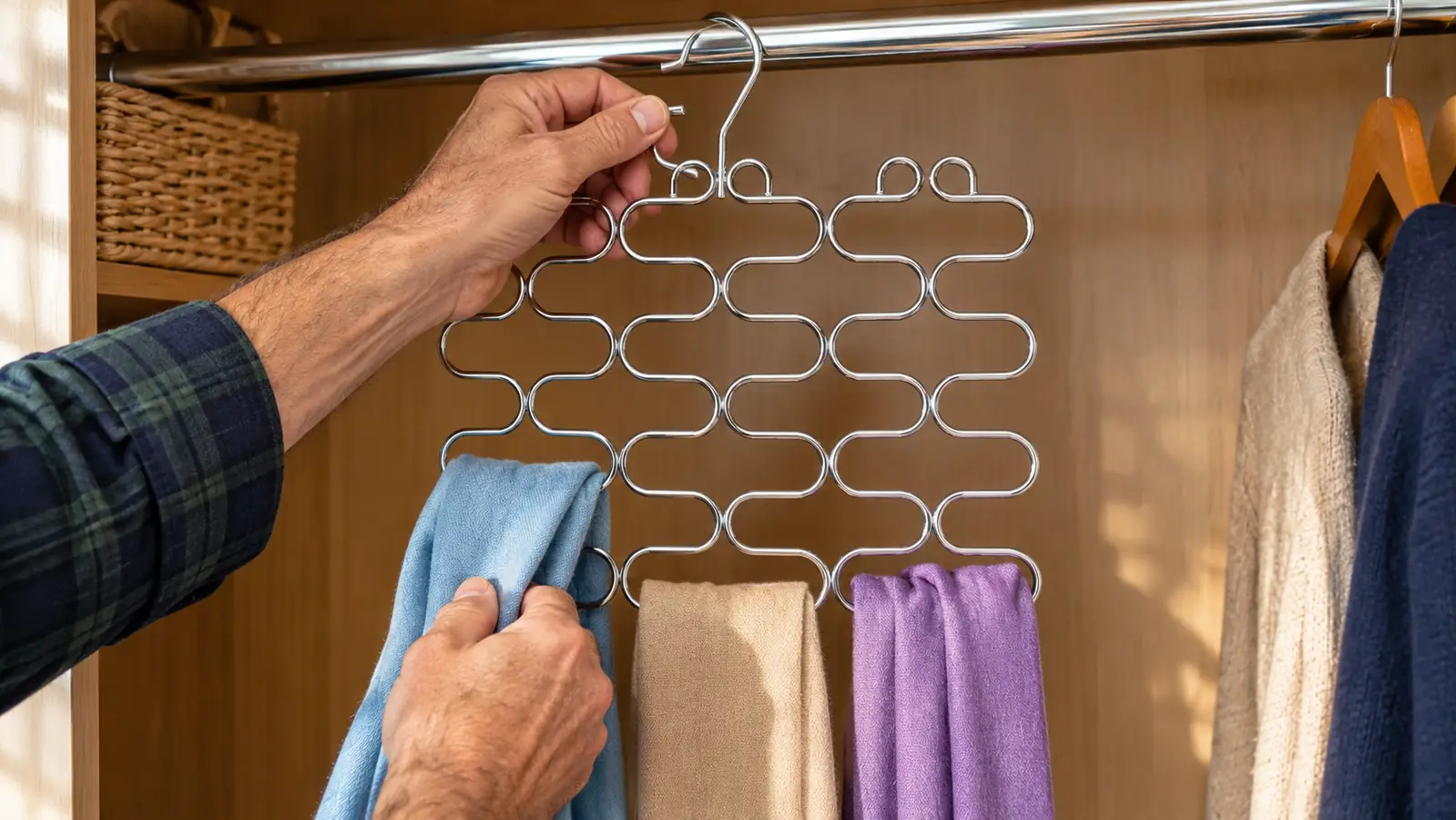
Visibility is the whole case, and it is a stronger case than it sounds. Twenty three loops on a triangular metal frame means every scarf has its own slot, and every slot faces you the moment the closet door opens. In six weeks I did not once have to lift a stack to find the cream and rust one I wear with the tobacco blazer. It was simply there. One of my Thursday lunch friends tried it and found three scarves she had forgotten she owned, which she called a win and I called a shopping problem.
The second thing it does well is hold the shapes you cannot fold. Belts and ties. Folding a belt is a nonsense. They coil, they tangle, and they take up a corner of a drawer for no reason at all. On a loop they hang straight and they stay straight. Same story for a long silk scarf, which wants to hang full length so the creases fall out overnight. A folded silk scarf gets a crease pressed into it by the weight of everything stacked above, and that crease does not always come out with a steam.
Belts are where I noticed it most, actually. I had eleven of them at the start of this, and eight of those lived in a tangle at the bottom of the drawer because coiling them never held past a day. On the hanger they hang straight down and they stay straight, and the one I want is the one I can see without unknotting anything first. Ties hang the same way. Scarves are the reason I bought it, but belts and ties are the reason I kept it up. I did not expect that. I thought it would be a scarf thing, and it turned into the spot where everything long that I could not keep folded now lives.
Twenty three loops sounds like a lot until you count. I counted: fourteen scarves, six belts, three ties, and there was still one loop empty at the bottom.
Where Drawer Folding Wins
Now the other side, because there is one and I am not going to pretend otherwise. A drawer costs you nothing in closet rod space and the hanger does. At 16.75 inches tall and 13.1 inches wide it hangs off the rail and takes that much room away from your blouses and dresses. In a small closet that is a real trade, not a rounding error. My dressing room closet is wide enough that I did not mind. My Thursday lunch friend with the shallow closet in an older house took one look and said she would have to move her dresses along. She was right.
The other honest drawback is weight. The frame is rated to 16 ounces, and that is not much once you get into beaded work or heavy wool. A beaded evening scarf hanging from a loop pulls at its own fabric where it sits on the metal, and if you load the heavy ones on one side the whole frame drags that way and hangs crooked. Those pieces are happier lying flat in a drawer with nothing pulling on them. I moved two of mine back into the dresser, and I would do it again.
The drawer also wins for anything going in a suitcase, which I did not think about until I packed for a wedding in Jacksonville. A folded scarf lies flat and stays flat, while a hung one keeps a soft fold mark where it went over the loop. If a scarf has to be perfect when you land, fold it, lay it flat, put something heavy and clean on top overnight, and leave it alone. The hanger is for the everyday rotation. Used properly, the drawer is a press.
23 loops that put every scarf where you can actually see it
The Deco Brothers scarf hanger hangs on the rod, takes 16.75 by 13.1 inches of rail, and keeps scarves, belts and ties reachable without digging. Rated to 16 ounces, so the beaded pieces stay flat in the drawer.
Amazon Check today's price on Amazon →
What the 23 Loops Actually Hold
Let me be plain about capacity, because 23 can mean anything until you fill it. My count was 14 scarves, six belts and three ties, and I still had one loop empty at the bottom. The loops are not all the same useful size. A narrow tie loop will not take a wide pashmina. A long silk scarf threads through and hangs with plenty of tail below. A chunky knit scarf will fight you, and honestly a knit scarf should be folded anyway, so that is not much of a loss.
The frame measures 16.75 inches tall and 13.1 inches wide, and the shape is triangular, narrow at the top where it hooks and wider at the bottom where the loops spread out. That triangle matters more than it sounds. The wider bottom means long scarves hang clear of each other instead of pressing together, and the narrow top means it does not shoulder your blouses aside the way a second rod or a shelf would. Mine sits against the left wall of the closet and the dresses hang past it with room left over.
One more thing nobody tells you: threading versus draping. If you drape a scarf over a loop instead of threading it through, a slippery silk one will slide off by morning. Thread it, the way you would thread a belt, and it stays put. That is not a fault in the hanger, that is how loops work. But it took me two tries to figure out, and one of my scarves spent a night on the closet floor learning it for me.
What Annoyed Me About Each
The frame swings. Hang it empty and it tilts and clatters when you push clothes past it, which is the nature of anything hanging from a rod and not a defect, but it is irritating at seven in the morning. I ended up parking it at the far end of the rod against the wall so it stops moving. And because it is thin metal, the whole thing is lighter than it looks, which is kind to the rod and unkind to heavy loading. Sixteen ounces is the ceiling. Respect the ceiling.
The drawer annoyed me in the opposite way. It never broke, never swung, never asked anything of me. It just quietly made me forget what I owned. I pulled everything out, refolded it, put it back, and three weeks later it was a heap again. That is not the drawer's fault either. It is what a horizontal stack does when you take things from the middle and put them back on top.
What I Liked
- Every scarf, belt and tie visible at a glance
- 23 loops on one triangular metal frame
- Holds belts and ties that folding ruins
- 16.75 inches by 13.1 inches, so it does not eat much rod
- Silk hangs full length and the creases drop out
Where It Falls Short
- Rated to 16 ounces, so beaded and heavy wool pieces drag
- It takes rod space away from clothing
- A draped silk scarf will slide off a loop if you do not thread it
- It swings on the rod when the closet is crowded
Who Should Buy Which
If you wear a scarf, a belt or a tie more than once a week, get the hanger. That is the whole test and it really is that simple. It goes on the rod, it holds 23 pieces in a space 16.75 inches tall and 13.1 inches wide, and it turns something you own into something you can see. It suits a dressing room or a wide closet where you can spare the rail, and it suits anyone who has ever bought a second scarf because the first one was buried somewhere in a stack.
If your scarves are mostly heavy wool, beaded or otherwise fragile, or if your closet rod is already crowded to the point of complaint, keep folding. A drawer with nothing pulling at the fabric is kinder to those pieces, and it costs you no closet space whatsoever. Most of us are both people at once. That is why I have the hanger at one end of the rod and a folded stack still in the dresser. That is not a failure to decide. That is deciding properly.
One last thing, and this is the nosy part. Ask yourself when you last wore the scarf at the bottom of the pile. If you cannot remember, that scarf is not being stored, it is being archived, and a drawer is a fine archive. The hanger is for the ones in rotation. I wish someone had made that distinction for me years ago, before I bought a second cream scarf because the first had gone missing in a stack. It had not gone missing. I could not see it. Two scarves later, I finally fixed the actual problem.
Put the scarves where you can see them, not where you have to dig
One hanger, 23 loops, 16.75 inches tall by 13.1 inches wide, and a place for every scarf, belt and tie you keep meaning to wear.
Amazon See the Deco Brothers scarf hanger on Amazon →