I have a dresser drawer that used to be a scarf drawer. Not a drawer for scarves, a drawer that scarves had taken over, the way a spare room gets taken over by boxes you mean to sort someday. Every fall I would open it, dig for the cream one with the peacock print, and pull four others out with it. By the time I found what I wanted, the drawer looked worse than when I started and I was already late for lunch with the Thursday group.
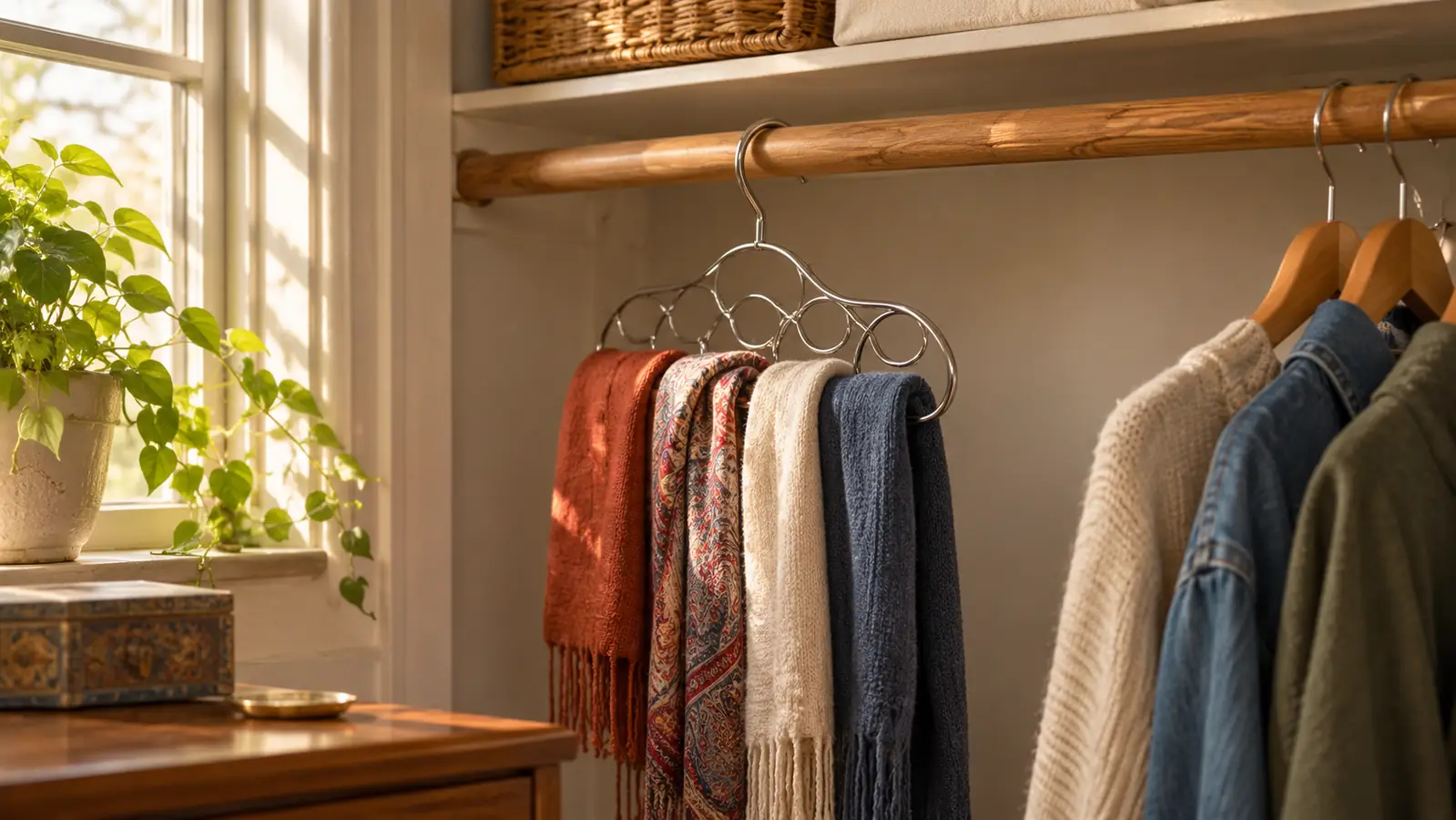
Last spring I quit the drawer. I hung a Deco Brothers scarf hanger on the rod in the closet of my dressing room, one hook and twenty-three loops, and moved the whole collection onto it in a single afternoon while Walt stood in the doorway asking whether I had thought it through. I had not, particularly. But it worked, and I have used it every day since, through two Florida summers, one closet clean-out, and a visit from Becca that cost me six scarves. What follows is what several months of ordinary use actually looks like, including the two things about it that still bother me.
The Quick Verdict
Twenty-three loops that hold silk, wool and belts in plain sight. Keep the load under a pound and it does its job.
Amazon Check Today's Price →The drawer problem ended with one hook and twenty-three loops
This is the hanger my scarves live on now. The listing shows the loop count, the size and the current price, so measure your rod before you order.
Amazon Check Today's Price on Amazon →How I've Used It
My dressing room is the spare bedroom, and the closet in it is a plain reach-in, not a walk-in. The rod sits at about eye level for me, which matters more than I expected, because I can see every loop without standing on anything or dragging out the step stool. I hung the hanger toward the left end, where the scarves I wear most already lived, and left the right side for coats. That was the entire installation. The hook goes over the rod, you give it a small turn so it sits level, and you are done. No brackets, no drilling, nothing Walt had to be called in for.
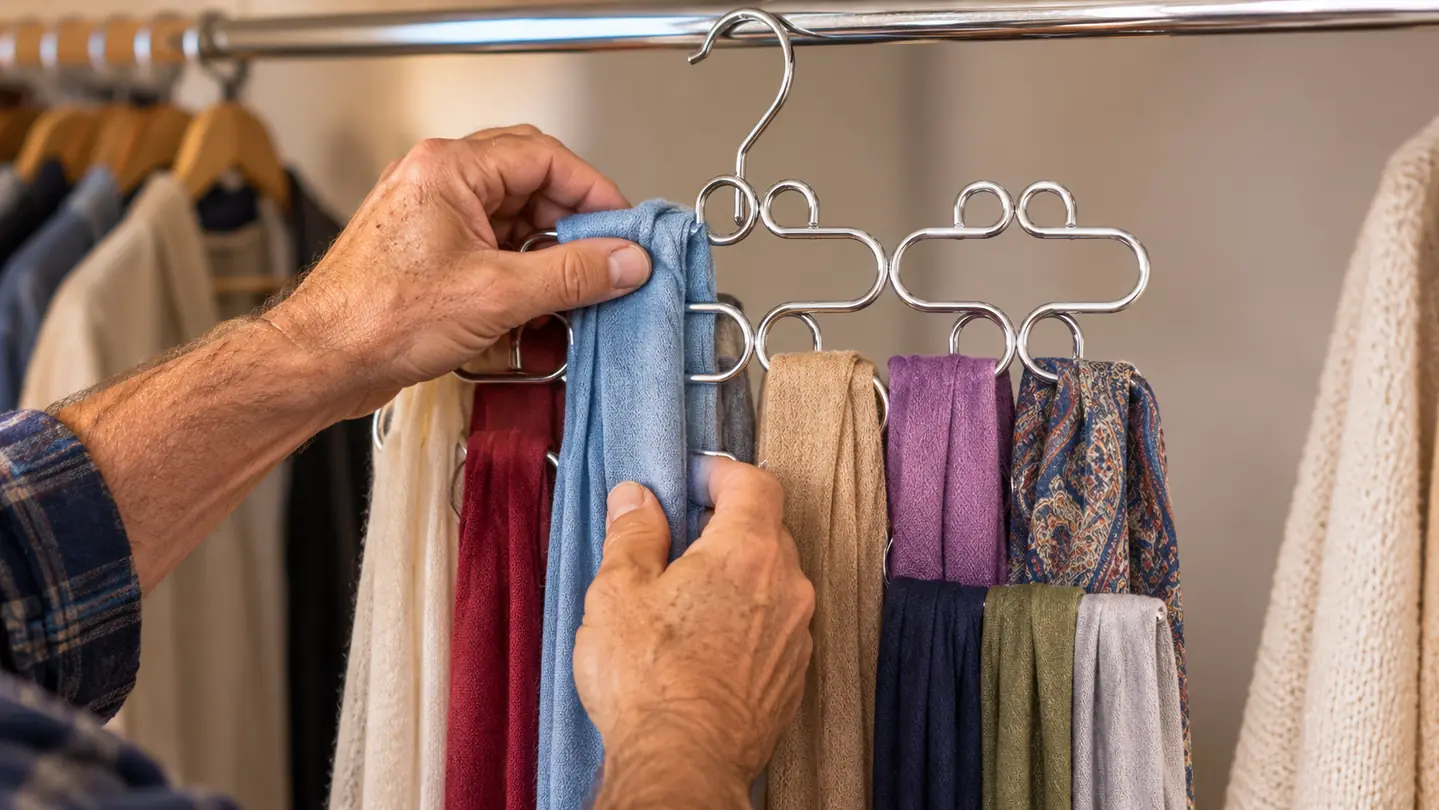
The first week I loaded it wrong. I put two light scarves on each loop, thinking I was being efficient, and by Wednesday the whole thing had become one bundle. Pull one out and three came with it. So I started over, one scarf per loop, folded lengthwise twice and slipped through, and that is when it began earning its place. Now I stand in front of the closet, scan the loops the way I used to scan a rack at the accessories counter, and take exactly the one I want. Twenty seconds and no ironing.
I tried one other thing before I settled on the loops. I bought a set of slim velvet hangers and hung each scarf over the bar of one, which looked tidy for about four days and then turned the left side of my closet into a wall of fabric I could not see past. Thirty scarves on thirty hangers is a lot of rod. That was the week I ordered the Deco and stopped arguing with the closet.
I should describe what my routine looks like now, because that is the honest test of any organizer. Weekday mornings I take one scarf off, wear it, and hang it back on the same loop that evening. Once a month I pull everything down, wipe the frame with a dry cloth, and put the scarves back in seasonal order. That is the whole maintenance schedule. There are no moving parts to wear out and nothing to adjust, which at my age I count as a feature rather than a shortcoming.
The other surprise was how much I had forgotten I owned. That sounds like a small thing until you have spent years losing scarves at the bottom of a stack. A rust and gold silk I bought at an outlet mall years ago and had not worn since came back into rotation the week I hung it up. So did a long black and white one that turns out to be the only thing that works with a particular coat. Seeing them all at once does something a drawer never did for me.
What Twenty-Three Loops Actually Hold
The listing says twenty-three storage compartments and the title says twenty-three loops, and both are accurate. I counted mine twice, the second time because Walt did not believe me. In practice that is twenty-three scarves if you use one per loop, which is what I do. The loops are sized for a folded scarf rather than a bundled one, so a standard square silk or a long lightweight rectangle slides in easily and stays where you put it. Thin cotton scarves take up almost no room at all, and in theory I could double up on those, though I have learned my lesson about doubling up.
To give you a real number rather than a hopeful one, I counted on a Saturday in October with the whole collection laid out on the spare bed. Fifty-one scarves in all. Twenty went onto the Deco Brothers hanger, four belts took the bottom loops, and the rest went into a single storage bin on the shelf above, which is a far cry from the three bins I used to keep. Anything I wear in a normal month lives on the hanger. The bin is for the formal pieces and the two I keep only because Becca gave them to me.
Where it runs out of room is with the heavy pieces. A wide wool wrap or a thick knitted scarf takes a loop and then spreads into the two beside it. I have one oversized blanket scarf that I finally took off and put back on a hanger of its own, because it was making the whole row look drunk. So the realistic count for me is twenty scarves, plus a couple of loops doing lighter duty with belts at the bottom. That is still nineteen more scarves in plain view than I had before, and I can find any one of them without turning on the overhead light.
One thing worth saying: the loops are open, not clipped and not gripped. Nothing pinches the fabric, which is exactly what I wanted for silk, but it also means nothing holds a scarf at a tidy angle. If you are the sort of person who wants everything squared off and even, this will not give you that. It gives you reach and visibility, and you trade a little neatness for it.
Fitting It Into a Real Closet
The measurements are 16.75 inches high and 13.1 inches wide, and those numbers are worth checking against your own rod before you order. Height is the one that matters most. My rod has roughly thirty inches of clearance to the shelf above, so the hanger hangs with room to spare and the longest scarf still clears the shelf. If your rod sits close under a shelf, measure first, because a scarf hanging from a bottom loop needs a few inches of drop below the frame as well as the frame itself.
I measured mine with a metal tape because the cloth one kept flopping. From the top of the rod to the underside of the shelf is thirty-one inches. The frame is 16.75 inches tall, so it hangs with about fourteen inches to spare, and the longest scarf I own still clears the shelf when it is doubled through a loop. If your rod sits a foot under a shelf, the frame is not the trouble, the scarf hanging from a bottom loop is.
Width is the easier number. Thirteen inches is about the width of two coats pressed together, so it does take real rod space. I moved a jacket to the right side to make room and never missed it. What I like is that it uses vertical space in a closet where I had been using none at all. The floor of my closet still holds the shoe rack and the laundry basket, the shelf above still holds the hat boxes, and nothing had to be rearranged except the scarves themselves.
The Sixteen-Ounce Limit Is Real, and I Hit It
The listing gives a maximum weight recommendation of sixteen ounces, which is one pound, and I want to be plain about this because it is the one specification that changed how I use the thing. Silk and light cotton weigh nothing. Twenty-three of them together do not come close to a pound. Wool is another story. The week I loaded every winter scarf onto it at once, the hook began to lean away from the rod and the whole frame sat crooked. It did not fall, but it clearly wanted to.
My fix was simple. Winter wool went on first, spaced out, with lighter silks filling the loops between them, and the two heaviest wraps moved to a separate hanger entirely. Since then the Deco Brothers hanger has sat level and I have stopped thinking about it. If your collection runs to thick blankets and big wraps, this is not the tool for those, and no amount of careful loading will change it. It is a scarf hanger, and most scarves are light by nature.

What It Did for My Belts and Ties
The recommended uses on the listing are scarves, belts and ties, and I tested all three. Belts work better than I expected. I roll each one once and hang it over a loop, buckle side out, and they stay put without the kinks I used to get from folding them into a drawer. I have six belts on it now and they take up four loops at the bottom, which leaves the upper loops for the scarves I want to reach quickly in the morning.
Ties are fine too, though Walt's are the only ones in this house and he keeps his own on a rack in the bedroom, so my test there was short. What I would say is that a stiff leather belt will slide down to the bottom of its loop and sit there, and a very slippery tie will travel the same way. Not a problem, exactly, just not the neat drape the product pictures suggest. Loosen your expectations of perfect geometry and it works.
Silk, Wool, and What Slides
Here is the detail I did not expect. Slippery fabrics migrate. A fine silk scarf, hung on a loop and left alone, will work its way down over a few days until the tail hangs below the frame. It never falls off. It just rearranges itself differently than you left it. I noticed this most in summer, when the closet gets warm and I am pulling scarves in and out all week and giving the silk more chances to travel.
One morning in July I pulled a cream silk off the third loop from the top and its tail came down six inches lower than it had been the night before. Nothing had fallen. It had crept while the closet sat shut in the summer heat. I moved the four slipperiest silks to the top row, just under the hook where the loops are smallest, and they have stayed put well enough that I stopped checking them.
Wool and cotton stay exactly where you put them, so the practical answer is to hang silk on the top loops where there is less room to slide, and put the fabrics with a bit of tooth on the lower loops. That is not in any instruction sheet. It is just what several months taught me. None of my scarves have snagged on the metal, which was my other worry going in, and I have checked the silks carefully because I am fussy about them.
What I Liked
- Twenty-three loops hold a full scarf collection in one place and in plain sight
- Hangs straight over the rod with no hardware, no drilling and no assembly
- Belts and ties work nearly as well as scarves, especially rolled belts
- Nothing clips or grips the fabric, so silk comes off without snags
- Uses vertical closet space that hanging clothes never touch
- Easy to wipe clean and needs no maintenance beyond re-sorting
Where It Falls Short
- The sixteen-ounce limit means heavy wool wraps have to live elsewhere
- At 13.1 inches wide it takes real rod space away from coats
- Slippery silks slide down their loops over a few days
- The loops cannot be adjusted, so small items bunch at the bottom
- The frame sits crooked if you overload one side
Twenty-three scarves in plain sight, one per loop, and I have not dug through a drawer since spring.
Who This Is For
This suits someone with a working collection of scarves and a closet rod with a bit of clearance above it. If you wear a scarf two or three times a week and you are tired of pressing creases out of a folded stack, this solves that in an afternoon. It suits anyone who has belts coiled in a drawer and would rather see the buckles at a glance. And it suits a small closet, because it uses the vertical space that hanging clothes never reach. If you are the sort of person who likes to open a door and see what you own, it is built for you.
Who Should Skip It
Skip it if your scarves are mostly heavy wool, thick knits or oversized wraps. The sixteen-ounce limit is not a suggestion, and you will spend your mornings redistributing weight instead of enjoying the thing. Skip it if your rod is short and already crowded, because thirteen inches is a real cost in a narrow closet. Skip it if you want a system that clips, grips or compresses, since this one only loops. And if your whole collection is eight or nine scarves, a plain hanger will do and you do not need twenty-three loops taking up rod space.
If your scarves live in a drawer, they can live on the rod instead
Twenty-three loops, one hook, no assembly. Measure the clearance above your closet rod first, then check the size and current price on the listing.
Amazon See the Deco Brothers Scarf Hanger on Amazon →