I bought the Deco Brothers Scarf Hanger for a reason that had nothing to do with scarves. My silk scarves were living in a drawer of the long dresser in my dressing room, and every time I wanted the navy one I had to lift out eleven others first. By the time I found it, I had a pile to refold. One Tuesday in March I decided I was done with that.
So this is not a review written by someone who saw a pretty picture on a listing page. It is written by someone who has had this hanger on my closet rod since spring, has loaded it heavier than the manufacturer recommends, and has a short list of complaints that I am going to give you straight. If you only want the version where everything is wonderful, this is not that review.
I am 64, I spent 22 years working the floor and then the accessories counter at a department store, and I have opinions about how things are displayed. That is the lens here. I care less about whether a hanger is clever and more about whether it makes getting dressed in the morning easier. The short answer is yes, mostly, with two real annoyances.
The Quick Verdict
Holds 19 silk scarves and 4 belts without the frame sagging, but the 16-ounce weight recommendation is lower than the photos suggest and the narrow bottom creases long scarves.
Amazon Check Today's Price →The hanger that finally got my scarves out of the drawer
23 loops on a metal frame, 16.75 inches tall and 13.1 inches wide. Mine has been loaded and dragged off the rod since spring and the frame still holds.
Amazon Check Today's Price on Amazon →What the Deco Brothers Scarf Hanger Actually Is
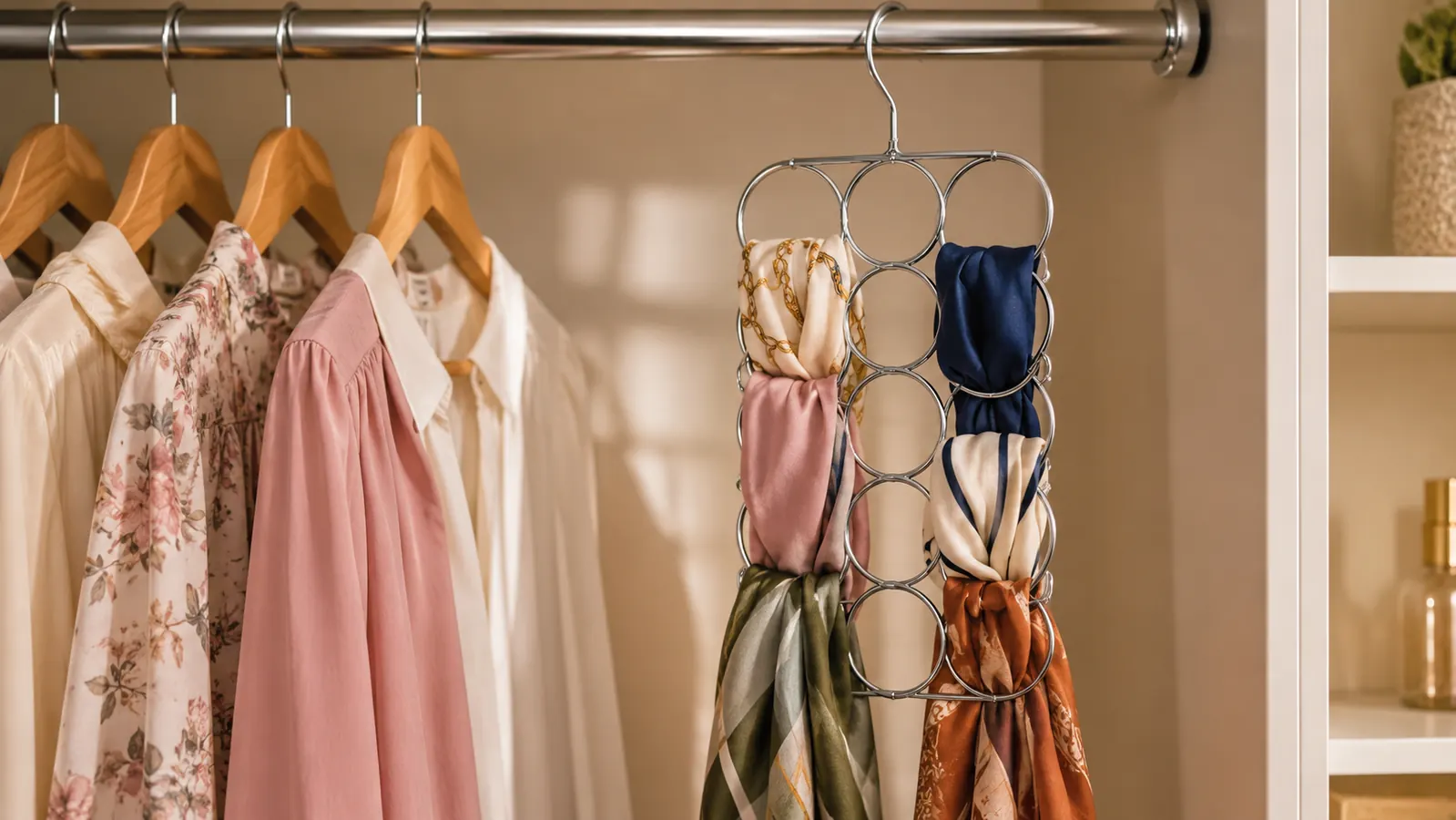
It is a metal frame, roughly triangular, standing 16.75 inches tall and 13.1 inches wide. Around that frame run 23 loops, and each loop is a compartment for a scarf, a belt, or a tie. That is the entire idea. There is nothing to assemble, nothing to adjust, nothing to install. You take it out of the box and hang it on the rod.
The Deco Brothers listing gives the recommended uses as scarf, belt and tie storage, and it gives the maximum weight recommendation as 16 ounces. I want to stop on that number, because it is the most useful piece of information on the page and it is also the one people scroll straight past.
Sixteen ounces is one pound, spread across the whole hanger and not per loop. That is not heavy hardware and it does not pretend to be. If your mental picture involves six winter wool scarves and a fistful of thick leather belts, you are already over the line the maker drew.
The metal is thin and the finish is even. The loops are formed cleanly, with no rough edges that would catch a silk hem, which matters more than it sounds. I ran a finger around every loop before I hung anything on it. Nothing snagged.

How I've Actually Used It
Mine hangs on the closet rod in my dressing room, right beside my blouses, and it holds silk. That is what I own and that is what this does well. Silk is light, it does not fight the loop, and a square folded on the diagonal slides in and stays put.
I counted what was on it this week. Nineteen scarves and four belts, which leaves no loop empty and no loop stretched either. When it is full the frame does not sag and the rod does not complain, because nineteen silk scarves together weigh less than the handbag I carry to lunch.
The belts were an accident. I had been rolling them into a basket under the hanging rod, which meant I could never see what I had and kept wearing the same two. Now they roll through the bottom loops and I can see every buckle at a glance. Small thing. It changed my mornings anyway.
The other use I did not plan for: I take the hanger off the rod and lay it flat on the long dresser when I am deciding what to wear. Laid flat, the whole collection is visible in one shape instead of a stack. For a Thursday lunch or a wedding, that is a different experience from pawing through a drawer.
It also became a drying rack, of all things. A silk scarf that picks up a spot at lunch gets hand washed, and it goes on an empty loop to dry in the air rather than over the back of a chair. That is not what it is sold for. It works anyway.
How It Looks in the Room
I did not expect a hanger to change how the closet looks, and it did. My dressing room is the spare bedroom, and the closet has bifold doors I keep open. Before, the rod held blouses and that was it, a row of hangers and a lot of empty air. Now there is a shape in the middle of it.
It reads like a shop fixture, which after 22 years on a department store floor is a compliment from me. The frame is thin enough that it does not block the blouses behind it, and the scarves hang in a fan that is pleasant to look at. Becca noticed it before she noticed anything else in the room.
The one visual complaint: because the loops are open, the ends of the scarves hang free and unevenly. If you are the sort who wants a closet to look like a photograph, trim the ends to similar lengths or wrap the long ones. I did not bother. It still looks better than the drawer did.
Nineteen silk scarves and four belts, and the frame has not sagged once. What it will not take is a heavy wool scarf, and the listing does tell you that on the weight line.
What Nobody Tells You About the 23 Loops
Twenty-three sounds like a lot and it is not. It is a specific number that fills up faster than you expect, and the loops are not equal in practice, because a bulky scarf takes more room than the loop technically offers.
Here is what I mean. A thin silk square takes one loop and behaves itself. A long, wide pashmina takes one loop and bulges sideways into its neighbors, so you effectively lose the loop on either side of it. If your collection is mostly thin silk, you will get close to 23. If it is bulky wool and cashmere, plan on 12 to 15 comfortable slots and no more.
Nobody told me that. The listing says 23 storage compartments, which is accurate, but the compartments are metal loops and not rigid boxes. Capacity depends entirely on what you feed them.
The loops are spaced closely enough that a scarf on one does not slide onto the next. I have not had a single thing drop to the closet floor, and I have bumped this hanger, dragged it off the rod, and carried it across the room loaded. Nothing slipped.
Ties are the use I have no experience with, since Walt has exactly four and keeps them on a rack he has had since 1994. But a tie rolls and a loop holds a rolled thing, so I would expect it to work. The listing groups ties with scarves and belts and nothing about the loops argues otherwise.
One more thing about the loops. They are open at the top. That is what makes loading fast and it is also what makes unloading fast when you pull a scarf out in a hurry. If you want things locked down, this is not that kind of organizer.
What Annoyed Me
The frame is a triangle, so the bottom is narrow. That is fine for belts and ties, which are thin and roll. It is not fine for a scarf you want to hang full length, because the bottom loops pinch it and you end up with a crease near the end. I moved my long scarves to the wide top and my short ones down, and that solved it. But I worked it out myself.
Second: it does not hold everything I own. I have more scarves than 23, so the overflow is still in the drawer. This did not eliminate the drawer. It made the drawer smaller and better organized, which is not nothing, but if you were hoping to empty it completely, count your scarves first.
Third, the weight line is real and it is lower than people assume. I once hung two heavier winter scarves on it and the frame flexed when I pulled the hanger off the rod. It did not break and it did not bend permanently. I took them off anyway and I am careful now.
Fourth, and this is small but it nags: the hook that goes over the rod is bare metal, and when I slide the hanger along the rod it makes a scraping sound I can hear from the next room. Walt has mentioned it twice. It is not a defect. It is just loud.
Fifth, and this one is on me as much as on the hanger: dust. Open loops with scarves hanging in the air collect it, and silk shows dust. In a drawer the scarves were covered. Here they are not. I shake them out more often than I used to, and that is the trade.
What I Liked
- 23 loops hold 19 silk scarves and 4 belts without the frame sagging
- Nothing to assemble, nothing to adjust, hangs straight on the rod
- Loops are smooth, so silk does not catch or pull
- Everything is visible at a glance instead of buried in a drawer
- Lays flat on a dresser when you are choosing an outfit
Where It Falls Short
- 16-ounce weight recommendation covers the whole hanger, not each loop
- Narrow triangular bottom creases long scarves
- Bulky wool scarves eat two or three loops each
- Bare metal hook scrapes audibly along the rod
- Scarves sit in the open and collect dust, which a drawer prevented

How It Compares to Folding Them in a Drawer
I folded scarves into a drawer for years, and the case for folding is real. It is free, it protects from dust, and it takes up no rod space. The case against it is that you cannot see what you have, so you wear the top four and forget the rest.
The Deco Brothers hanger fixes that specific problem and creates two smaller ones. It takes rod space, roughly 13 inches of it, and it leaves the scarves in the open. Whether that trade is worth it depends entirely on whether you have rod space to spare and whether your scarves are precious enough to want covered.
My honest answer after months of both: the hanger for the scarves I wear often, the drawer for the ones I do not. That is not a tidy conclusion but it is the true one. I did not replace my drawer. I split the collection.
What My Thursday Lunch Friends Said
I brought the hanger to lunch in April, which earned me a few looks, and passed it around the table. One of my Thursday lunch friends, who has a great many long silk scarves and very little closet space, asked where I got it before the food arrived. She has since bought one.
Another said it looked like something from a shop display, which is exactly right and is part of why I like it. It reads as a display piece and not a storage gadget, and in a dressing room that matters. The fourth, who is the practical one in our group, wanted to know how it handled belts. I told her fine, as long as they are not thick leather.
Not one of them asked about the weight limit, and I had to bring it up myself. That is the pattern. People see the shape and the loops and assume it is sturdier than it is, because it looks like shop fixture hardware. It is metal, but it is light metal.
Who This Is For
It suits someone with a scarf habit and a closet rod. That is the whole requirement. If you have a collection of thin silk, lightweight squares, or a belt problem, and you have been keeping them in a drawer because you did not know what else to do with them, this is a sensible fix.
It also suits anyone who wants their things visible. Half the value of this for me was not storage at all. It was being able to open the closet, look at the rod, and see what I own instead of trying to remember it.
It would also make a decent gift for a friend who has a scarf habit and a small closet, because it needs no explanation and no assembly. My one caution is the same one I gave my lunch group: tell them about the weight line, or they will hang wool on it and wonder why it flexes.
Who Should Skip It
Skip it if your scarves are mostly heavy wool, thick knit, or oversized. You will run out of usable loops quickly, the 16-ounce recommendation will become a problem, and the narrow bottom will crease the long ones.
Skip it if you do not have a rod to hang it from. It wants a closet rod or something similar. There is no version of this that works sitting in a drawer, which sounds obvious, but the product photos make it look like it might sit on a shelf. It will not.
And skip it if you want a permanent home for a collection you never prune. This is a display hanger and not a storage unit. It holds what you are actually wearing this season. The rest still needs somewhere to live.
One last thing, and then I will stop. I have owned a lot of organizers that solved a problem for a month and then became a problem themselves. The Deco Brothers hanger has not done that, because there is nothing to fall apart and nothing to operate. It is a metal frame with loops. I like it, I use it every day, and I wish someone had told me about the loop math and the weight line before I loaded it up and heard the frame flex.
If your scarves live in a drawer, this is the smallest fix I know
23 loops, metal frame, 16.75 inches by 13.1 inches. Read the weight line first, then load it with silk and belts and see how much easier a Tuesday morning gets.
Amazon Check Today's Price on Amazon →