
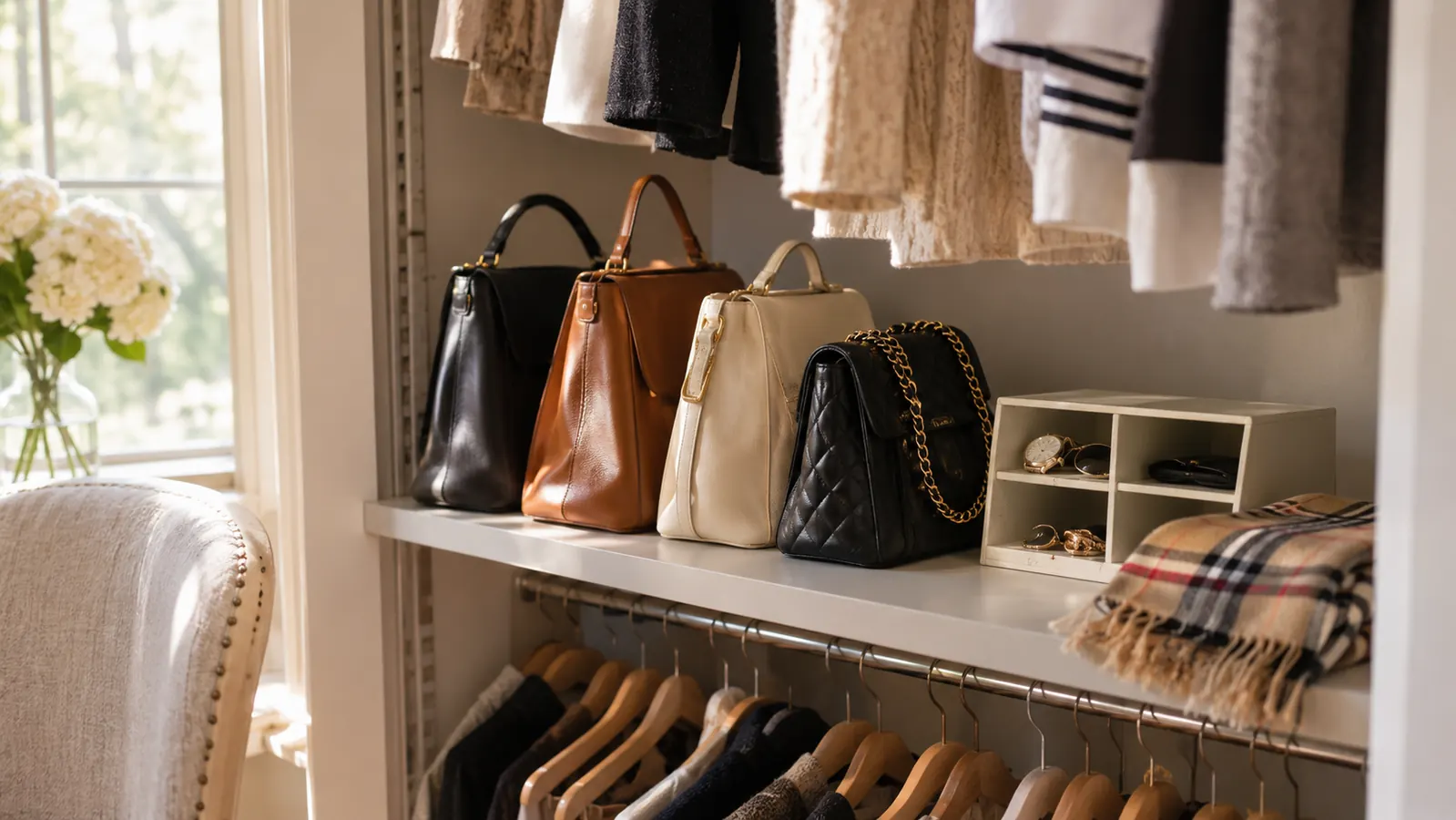
There is a moment in a closet clean-out when you stop sorting and start staring. Mine came on a Tuesday in March, standing in the spare bedroom I use as a dressing room, with eleven handbags on one shelf and no way to reach any of them without pulling down four. The one I wanted was always at the back. By the time I dug it out there was a pile on the floor and no interest in putting it back.
I am not a person who buys a gadget for every small annoyance. But after a month of stacking bags like firewood, I ordered the Lifewit purse organizer for that shelf, and it has stayed in place ever since, through a Florida summer that ruins anything left near a window. What follows is how I set mine up, in the order I would do it again, including the two things I got wrong the first afternoon.
Eleven bags, one shelf, nothing left to dig through
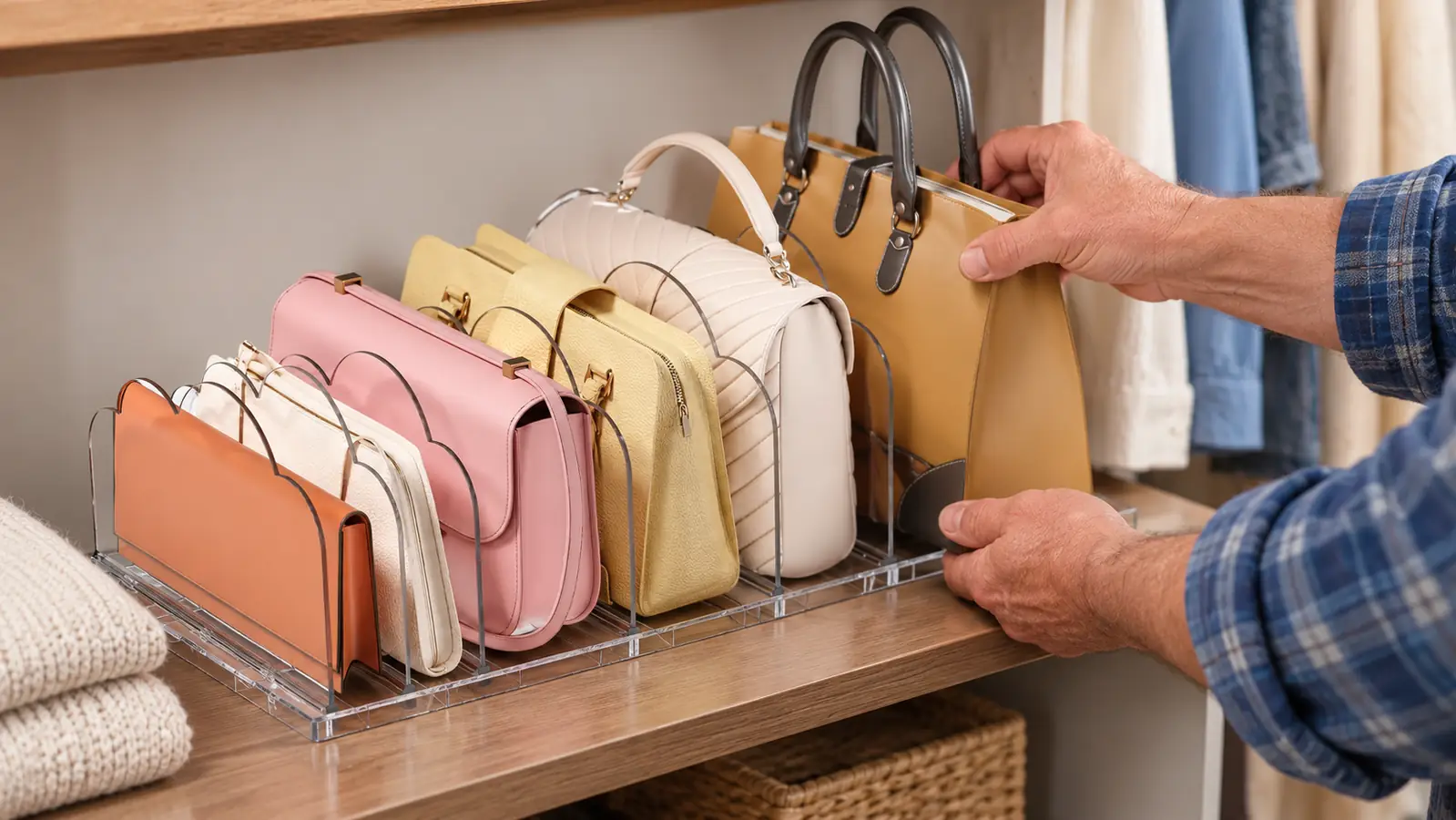
The Lifewit organizer sits flat on a closet shelf with no drilling and no tools. Two bases, seven dividers, spacing you set yourself, and clear sides so you can see what you own from the doorway.
Amazon Check Today's Price on Amazon →Step 1: Empty the shelf and be honest about what you actually carry
Take everything down. All of it, including the tote you keep meaning to sell and the clutch my daughter Becca wore at her wedding. Put the whole lot on the bed in the spare room, because you need to see the true size of the collection before you decide anything. Mine came to eleven bags laid out end to end, and I would have guessed seven if you had asked me from the doorway. Two of them still had a dry cleaning tag curled up in the pocket from a wedding the year before. Then sort into three piles: the bags you carry in a normal month, the bags that come out a few times a year, and the bags you keep because of who gave them to you or where you bought them.
That third pile is always bigger than you expect, and it does not belong on the shelf you use on a Tuesday morning. Mine went into a lidded box on the top shelf with a label on the end so I do not have to climb for it. Sentimental is fine. Sentimental sitting in the way of the bag you actually want is not, and I say that as a woman who has kept a beaded evening bag she has not carried since 1998.
Be strict about the first pile too. If you carry the same bag for six weeks straight, it does not need a permanent slot, though you will probably give it one anyway if there is room. The point of a shelf that works is that the answer to what am I carrying today takes about four seconds, and a bag you use daily deserves the easiest slot on the row, at the front and at the height of your hand.
Step 2: Measure the shelf and the tallest bag on it
The Lifewit organizer measures 24.6 inches long and 9.3 inches deep once the dividers are seated, and the dividers stand up to 6.5 inches tall. Write those three numbers on the back of your shopping list and take a tape measure to your closet shelf before you order anything at all. My shelf is 36 inches wide and 12 inches deep, so the organizer sits with a hand's width to spare, and I can still tuck a folded scarf down beside it without crowding the row. I measured that shelf three times, twice with a metal tape and once with the wooden folding rule Walt keeps in the kitchen drawer, because the first two numbers did not agree and I wanted to know why. The shelf is not square to the wall. It runs off by half an inch from one end to the other, which is exactly the sort of thing you find out after you have already ordered.
Height is the number most people skip and it is the one that decides whether you are pleased or annoyed six weeks later. A structured satchel stands above a 6.5 inch divider without any trouble. A soft hobo slumps over the top and leans on whatever is next to it. Measure the tallest bag you want to keep standing upright. If it comes taller than the dividers, that bag goes at the end of the row, or it lies flat, or it lives somewhere else entirely.
One small note about depth. The base is freestanding, so it does not have to be shoved flush against the back wall. Mine sits about two inches forward, which gives me a gap to run a dust cloth through and keeps the front lip of the shelf from hiding the first inch of every bag. If your shelf measures less than about nine and a half inches deep, measure twice before you buy.
Step 3: Snap the dividers into the base before it goes up
It arrives as two bases and seven dividers. There is no drilling, no tools, and nothing screwed into your closet, which mattered to me because the closet in that room is original to the house and I have done enough damage in my time. The dividers snap into the base and the base sits on the shelf under its own weight. Nothing is permanent, which means you can change your mind about the whole layout on a Saturday afternoon.
Do the snapping on the kitchen table, not up on the shelf. Lay a base flat, hold a divider straight up and down, and press until it seats. If one fights you, it is turned around. Get all seven seated before you carry anything into the closet, because juggling a half built organizer at shoulder height is how people give up on a thing before they have used it once.
The mistake I made: I set the spacing as I went. Snap, change my mind, pry it up, snap again. Seat every divider first, carry the whole thing to the shelf, and adjust the spacing once it is sitting in front of you with the bags waiting beside it. The spacing is adjustable, that is the entire idea behind the design, but you want to be adjusting from a full set rather than rebuilding it one bag at a time.

Step 4: Set the spacing around your widest bags, not your narrowest
Here is the trap, and I walked into it head first. You start at one end with a clutch, and by the time you reach the other end you have seven skinny slots and nowhere to put the bag you carry every single day. Then you spend an evening sliding dividers around and wondering why the organizer made your shelf worse instead of better. I did that twice in one evening, and the second time I said a word out loud that I will not repeat here.
Go widest first. The structured satchel takes one full gap. Then the medium shoulder bag. Save the narrow end for clutches, wallets and the small bags that used to live in a drawer in the hallway. My two bases ended up with four wide slots and three narrow ones, and that matches what I actually own rather than what I imagined I owned when I ordered it.
Load front to back and stand each bag up on its own base with the handles toward you. Because the sides are clear, you can see the shape of every bag without lifting a single one, and that is the part that changed my mornings. I can stand in the doorway with a cup of coffee and spot the one I want in about four seconds. The first week I kept reaching for a bag and then setting it back slightly wrong, and by Friday the row had a lean to it like a fence in a wind. Standing the bag up straight, handles forward, takes one extra second and saves you the whole Saturday. The listing also says it takes folded shirts and sweaters, and one of my Thursday lunch friends uses hers exactly that way in a guest closet.
Step 5: Give it ten minutes on the first Saturday of the month
Any shelf drifts. A bag comes off, gets set down at an angle, and by the third week the row looks like a jumble sale again. On the first Saturday of the month I take everything off, wipe the base with a damp cloth, and put it back widest first. Ten minutes, and it is the only upkeep the thing has asked of me since spring. I do it on the same morning I water the plants on the dresser, so it is already part of the routine and I cannot pretend I forgot.
While the shelf is empty, look for what has not moved. If a bag has not left the shelf in a year, it goes into the lidded box, and the shelf stays useful instead of turning into storage. That is the trade I make now, and I cannot say I have missed one of them. Walt has noticed, mostly because the floor of that closet is visible for the first time in a decade.
The build has held up better than I expected. It is thick plastic with ribs running under the base, and after months loaded with leather it has not bowed or sagged in the middle. The edge of each divider is shaped in a soft wave rather than a sharp line, so there is nothing pressing a crease into a strap. There is a one year warranty from Lifewit, and I have not needed it, which is the way I prefer a warranty to go.
Eleven bags went from a pile I had to dig through to a row I can read from the doorway. The dividers do the work. Being able to see through the sides is what made the difference.
What Else Helps
A few extras made that shelf work harder than the organizer alone. I keep a stack of cotton dust bags in the closet and slip the out of season bags into them before they go into the box, which saves me wiping them down every time I swap. If you buy nothing else, buy those. You can find them for very little, and I have used the same six for years. Mine started as the flannel bags that used to come inside good shoes, and I have added to the stack every time a store hands one over. Wash them once a season on cold and let them air dry, because a hot dryer shrinks them down to nothing.
Scarves belong in a basket, not on the bag shelf. Roll them and stand them upright in something shallow so you can see the edges, and keep them clear of leather, because a silk scarf pressed against a strap for a season will pick up a mark. My basket sits on the same shelf and has made the whole closet feel calmer than any bigger piece of furniture ever did.
Dust shows on the clear sides, and honestly that is a good thing. You see it, so you deal with it. A damp cloth once a month is enough. Do not use anything abrasive on the plastic, and do not stack a heavy box on top of the organizer, because it is built to hold bags on a shelf, not to be shelved itself.
What it will not do: it will not hold a bag taller than the dividers standing up, it will not stop a soft bag from slumping, and it does not attach to anything, so a hard shove will slide it along the shelf. On a shallow shelf it will overhang the front edge. Those are the honest limits, and none of them have bothered me, but you should know them before you order.
The shelf you can see is the shelf you use
Two bases and seven dividers, spacing set to your own bags, nothing drilled into the closet. Mine has held eleven bags since March, and the floor of that closet has been visible ever since.
Amazon Check Today's Price on Amazon →