

My closet rod has held a lot of handbags by the straps over the years, and every one of them showed it eventually. The handles stretched. The bottom of the bag went soft and creased where it pressed against the wall. So I cleared off a shelf and tried the other way, letting the bags stand up in dividers instead of hanging from something. That is what the Lifewit Purse Organizer is: two bases and a set of dividers that snap into them, sold as a way to give handbags a shelf of their own.
Here is the short answer before the long one. The Lifewit wins if you have a shelf to give up and more than three or four bags, because standing a bag on a flat base keeps its shape, and clear dividers let you see what you own without lifting anything. Purse hooks win if you own a couple of bags, carry the same one all week, and have no shelf to spare. They are not really competing for the same job. Most of us need a little of both, in different corners of the same closet.
| Lifewit Purse Organizer | Purse hooks | |
|---|---|---|
| What it holds | Several bags at once, with the spacing set by where you snap the dividers | One bag per hook, two if the hooks are spaced apart |
| Shape over time | The bag stands on a flat base, so the body holds its shape and the straps carry no weight | The bag hangs from its handles, so the weight sits on the straps and the base can crease |
| Space it needs | About 24.6 inches of shelf length and 9.3 inches of depth, with 6.5 inches of height | A closet rod or the top of a door, and no shelf at all |
| Setup | Snap the dividers into the base, no tools and no drilling | Hang it and you are finished |
| Seeing what you own | Clear dividers, so you look straight at the bag you want without lifting anything | Bags sit at eye level on the rod, but the straps tangle once the rod is crowded |
| Best for | A shelf with five or more bags on rotation | The two or three bags you actually carry |
Where Lifewit Wins
The first thing the Lifewit does better is nothing dramatic. It lets a bag sit the way it was built to sit. A handbag is designed to rest on its base, with the weight coming down through the bottom panel the maker stiffened for exactly that. Hang it from a rod and all that weight moves into two thin handles, in one spot, for months at a time. Set it upright between dividers and the straps carry nothing at all. My structured bags came back into shape in about a week and stayed there.
The second thing is that you can see everything. The dividers are clear on every side, so the shelf reads like a row of windows instead of a row of lumps. I owned two bags I had genuinely forgotten about because they lived in cloth bags at the back, and now they are in the rotation again. That alone was worth the shelf space. When you can see what you have, you use what you have, and you stop buying a fourth beige shoulder bag because you did not know you already owned three.
What the Lifewit Organizer Actually Holds
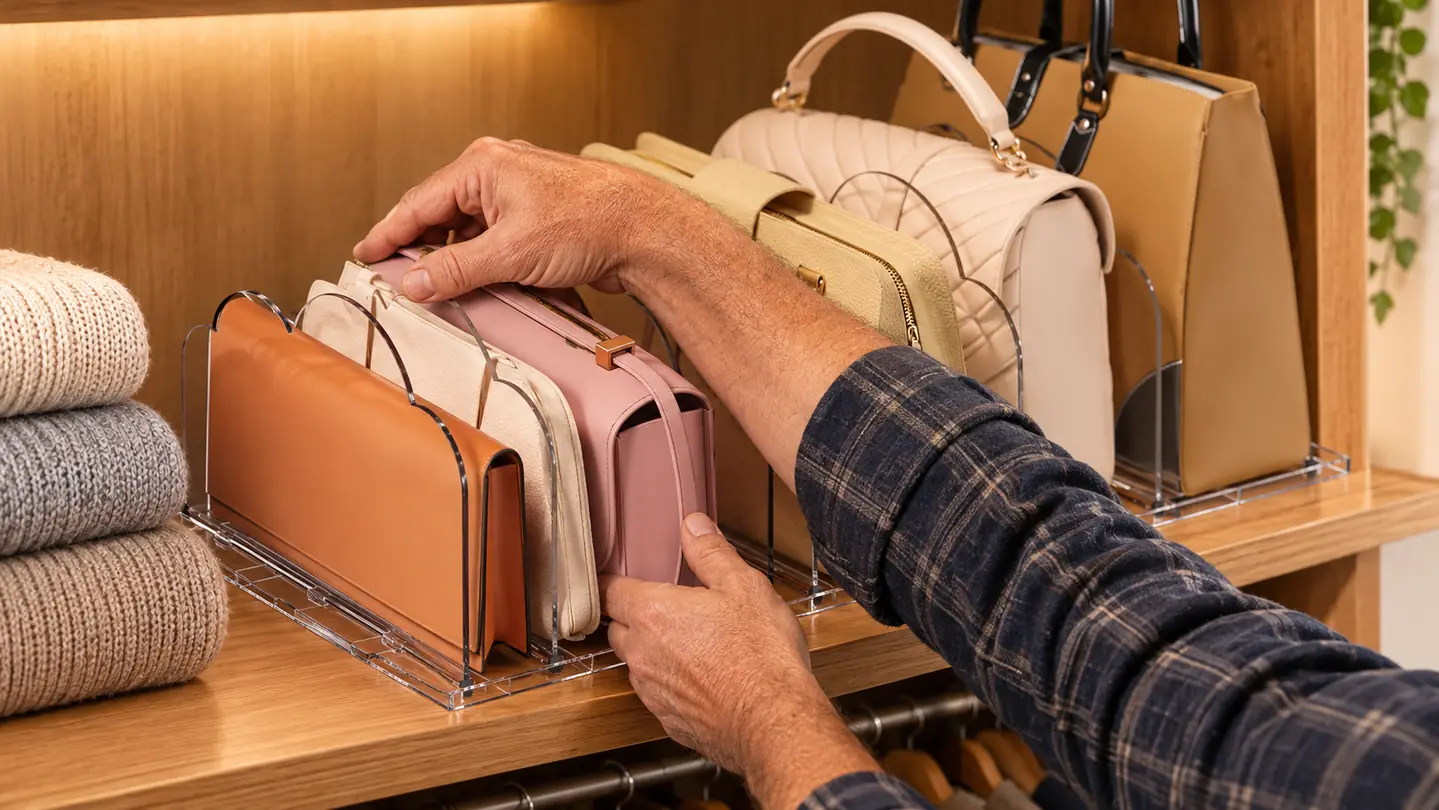
The set arrives as two bases and seven dividers. You snap the dividers into the base wherever you want them, and that is the whole assembly. No drilling, no screws, nothing attached to the closet itself. That matters more as I get older, partly because I am not climbing on a step stool with a drill in my hand, and partly because the closet is original to the house and I would like it to stay that way. Mine went together in about three minutes on the bedroom floor.
Snapped together, the run is 24.6 inches long and 9.3 inches deep, with the tallest dividers standing 6.5 inches. In practice that is two good shoulder bags, or three clutches and a wallet in the same stretch, or a stack of folded sweaters if you use it the way the listing also suggests. I put one base on the closet shelf and the other on the long dresser in my dressing room, which is where the bags I am actually carrying that week end up anyway.
Before this I tried a set of wire shelf dividers that grip the front edge of the shelf from underneath. They held for about a month, and then one of them started to lean whenever a bag pressed against it. By the time I noticed, the bag had folded over and creased along the side where the wire met it, and the wire had left two faint lines in the shelf finish. That was the winter before last, and I was annoyed enough to put the whole idea away for a year. The Lifewit rests its weight down on the shelf instead of pulling at the edge of it, and nothing has leaned since.
The plastic is thick, with ribs molded along the bottom, and it does not bow when a heavy bag leans against a divider. The edges are wave-shaped rather than squared off. That sounds like a line from a listing until you slide a soft leather bag past a corner and nothing catches on it. I have had flimsier dividers leave a faint line across the front of a bag. These have not, and the one year warranty from Lifewit is the kind of detail I check now that I have watched plastic crack on me before.
Where Purse Hooks Win
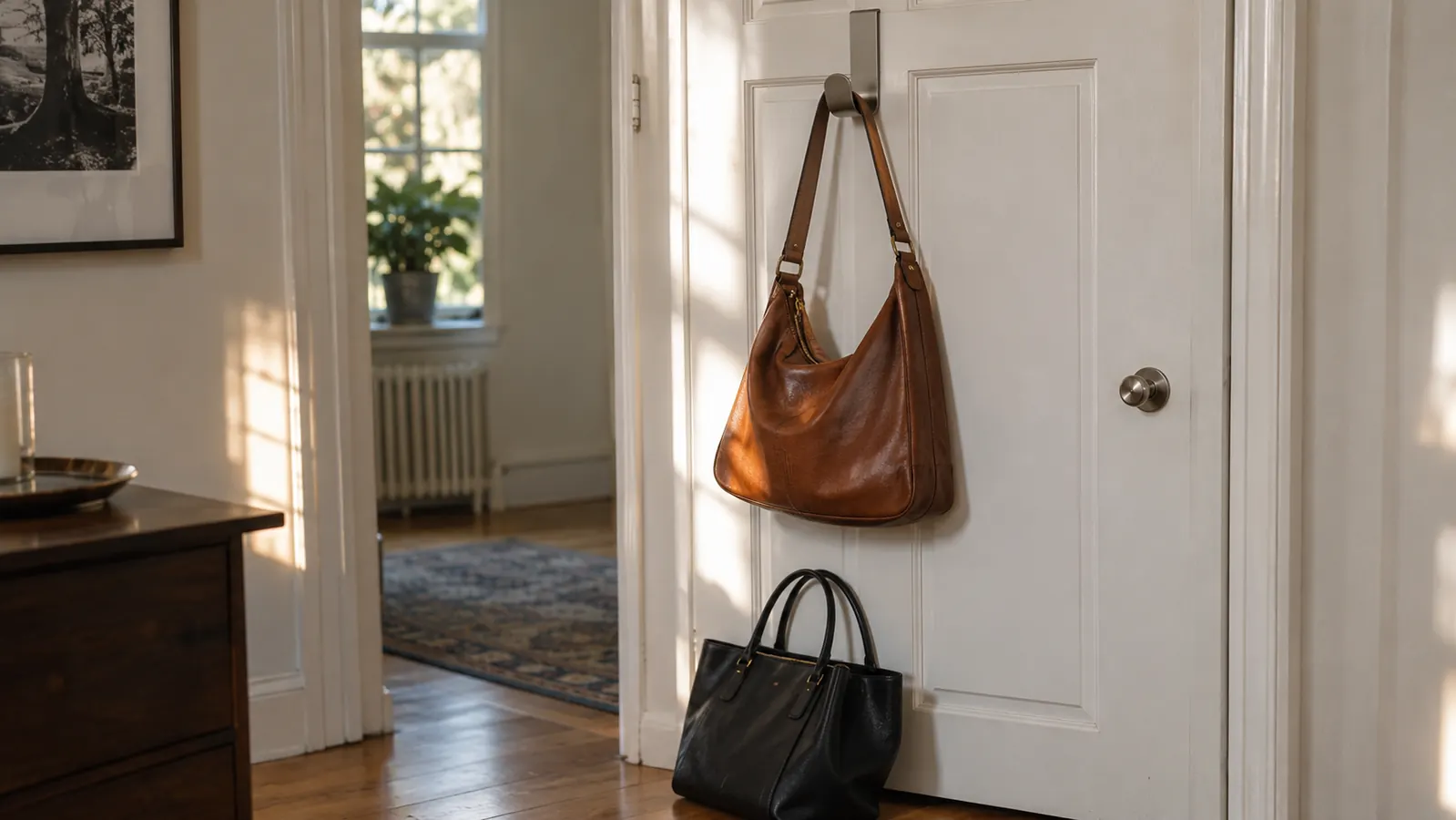
A hook asks nothing of your closet except a rod or the top of a door. If your closet has one shelf and it is already full of sweaters, hooks are the only answer that does not require you to move something else first. That is not a small point. Most storage advice I read assumes a closet with room in it, and plenty of us are working with a small ranch-house closet that was built for four dresses and a hat.
Hooks are also faster. The bag I am carrying this week hangs by the door, and I drop it there when I come in and lift it off when I go out. No divider to line up, nothing to open, no shelf to reach for. For two or three bags in daily rotation, that is the right amount of effort. A shelf organizer is for the bags you are not carrying this week, and it is honest to say so. Neither one replaces the other.
One of my Thursday lunch friends swears by the over-the-door kind and keeps four bags on it in a row. When I looked closely at them, three of the four had stretched handles at the top where the weight had been sitting for months. She had not noticed until I pointed it out, which is how these things always go. A stretch that happens a millimeter a week is invisible until somebody else stands in front of it and says so.
There is one more use for a hook that has nothing to do with storing a collection. It is a landing spot. My everyday bag hangs by the door with my keys in it, and that is the entire system. No sorting, no spacing, no shelf. If you have ever spent ten minutes looking for your keys, you already understand why that hook earns its place on the door.
The Trouble With Hanging a Bag by Its Straps
A shoulder bag is built to be carried for an hour or two at a time, with the handles taking the load from a hand and then letting go. Hang it for six months by one strap and that strap takes the entire weight in a single spot. Leather stretches. Chain straps kink. The base, which the maker stiffened so it would sit flat on a restaurant table, goes soft and rounds out because nothing is holding it up.
Dust is the other thing. A bag hanging in the open collects it across the top, which is the part you look at when you take it down. Bags standing on a shelf collect it on the sides and along the front, and it brushes right off. That is a small complaint until you pull out a bag for a wedding and find the flap has gone dull.
A bag that stands on a flat base keeps the shape it had the day I brought it home. A bag that hangs from one strap keeps the shape of that strap.
What Annoyed Me About Each One
The Lifewit has one real drawback, and it is space. It needs 24.6 inches of shelf, and it does not negotiate. My closet shelf gives me about 30 usable inches, so the organizer takes almost all of it, and I lost the corner where I used to pile scarves. The scarves moved to the dresser. Measure before you order, because the two bases do not have to sit side by side, but a single base holds less than you expect once a bag or two is standing in it.
I measured my shelf with a cloth tape on a Saturday afternoon and got 31 inches, then found out the hard way that the shelf bracket eats four of them at the end. If you are within an inch or two of the length, put the second base on another shelf instead of trying to force both onto one. Mine ended up split between the closet and the dresser and I like it better that way anyway.
The second annoyance is height. Six and a half inches is generous for a clutch, a wallet or a mid-size shoulder bag. It is not enough for a tall tote, which will not stand upright under the dividers and has to lie down. I have one big tote that lives on the top shelf by itself, and I have made my peace with that, but if your closet is mostly totes, this is not the organizer for you.
The hooks annoyed me for the reasons above, and for one more: the hook itself. A narrow metal hook can leave a faint line across the inside of a soft handle, and a mark in leather is a mark for good. If you go the hook route, use wide ones and hang the bag by both handles when the shape allows it, so the weight is shared between them instead of landing on one strap.
If You Are Starting With an Empty Shelf
Clear the shelf first, then put the bags you use most at the height of your hand rather than the height of your eye. The pretty ones can go high. Then sort by size: structured shoulder bags standing between dividers at the front, clutches and wallets in their own stretch, soft slouchy bags at the ends where nothing presses on them. Leave an inch or two of play in the spacing, because a bag wedged in tight is a bag you will stop putting back.
I did my whole shelf on a Saturday morning with a mug of coffee going cold on the dresser beside me. It took about forty minutes, and most of that was opening dust bags and deciding. Two bags I had not carried in over a year went into the donation box, which freed the corner of a shelf in the spare room and made the whole job worth doing twice over. If you start early you can finish before lunch and still get to the thrift store.
If the shelf is shallow, check the depth before anything else. The Lifewit needs 9.3 inches front to back, which most closet shelves have and a good many bookcases do not. And if the shelf is high, keep a step stool nearby. The whole point is to see your bags at a glance, and you cannot see them from the floor.
What I Liked
- Dividers snap where you want them, so the spacing changes with the bags
- Clear sides let you see every bag without lifting one
- No drilling and no tools, so the closet itself is untouched
- Thick plastic with ribs along the bottom, and it does not bow under a heavy bag
- One year warranty from Lifewit
Where It Falls Short
- Takes 24.6 inches of shelf length, which is more than some shelves have
- Dividers top out at 6.5 inches, so tall totes will not stand under them
- Once a divider is snapped into place, that spacing is set
- It is plastic, and it looks like plastic on an open shelf
Let the bags stand on their own bases instead of hanging by one strap
Two bases, seven dividers, no tools, and a clear view of everything you own. It fits a shelf about 24.6 inches long and 9.3 inches deep.
Amazon Check Today's Price on Amazon →Who Should Buy Which
Buy the Lifewit if you have a shelf you can give up and five or more bags, especially the structured ones. Buy it if you have ever opened a dust bag and could not remember what was inside. Buy it if your closet already has a shelf sitting there doing nothing but collecting hat boxes and a spare blanket.
Buy hooks if you own two or three bags and carry the same one for weeks at a time. Buy them for the door by the entry, for the guest room closet, for the bag that goes to Thursday lunch and comes home with a receipt in it. And if you are like me, do both. The Lifewit holds the collection on the shelf with the straps hanging free, and one wide hook by the door holds whatever I am carrying this week.
The shelf version, for the bags you are not carrying today
Snap the dividers into the base, stand the bags upright, and see what you own at a glance. Nothing gets screwed into the closet.
Amazon Check Today's Price on Amazon →