

I have a dressing room in my Lakeland ranch house with one long dresser, one closet, and one blank wall I have been filling for years. I have tried a glass curio cabinet in that room, and I have tried the KOLIPI acrylic display case on the dresser. My short answer is this: for a small group of brooches, clip earrings, a folded scarf, or a few keepsake boxes, the KOLIPI case is the easier fit. For a full collection that needs shelves and a furniture piece, a glass curio cabinet still does the heavier job.
The KOLIPI Display Case for Collectibles measures 8 by 8 by 12 inches, or 20 by 20 by 30 cm. It weighs 0.98 kg. It sits on a tabletop. That last part matters more than it sounds. My dresser already holds a jewelry box, a lamp, and a tray of scarves. The KOLIPI case slides into that lineup without making me clear a corner or move Walt's reading chair. The glass cabinet in my spare room is handsome, but it owns the wall.
| KOLIPI Acrylic Display Case | Glass Curio Cabinet | |
|---|---|---|
| Footprint | 8 by 8 by 12 inches, sits on a dresser or shelf | Floor or large wall space, plus room to open doors |
| What it holds | A small group: brooches, clip earrings, a scarf, small figurines, keepsake boxes | Several shelves of collectibles, handbags, and larger pieces |
| Visibility | At tabletop height, close to my eyes | Glass shelves show a lot, but low shelves are harder to see |
| Dust | A case with sides keeps dust off the pieces I wear most | Doors help, but shelves and seams collect dust |
| Moving it | 0.98 kg, easy to lift from dresser to closet shelf | Heavy furniture, needs two people and a clear path |
| Room presence | Small and practical, blends into a dresser top | A furniture piece that makes a statement |
| Assembly | Needs assembly; manual and online install videos are included | Large and awkward to bring in; some assembly may be needed |
| Small spaces | Rentals, spare bedrooms, one dresser top | A dedicated wall in a larger room |
| A growing collection | One small group at a time | Room to add shelves and pieces |
| Cleaning | Wipe the outside, leave the inside alone | More shelves and seams to wipe |
Where KOLIPI Wins
The first win is placement. The KOLIPI case is 8 inches wide and 8 inches deep, so it fits on a dresser top or a closet shelf. I can lift it with one hand because it weighs 0.98 kg. When I want to vacuum under it or move it to the closet, I do not need Walt or a furniture dolly. A glass curio cabinet is a two-person job and a clear path through the house.
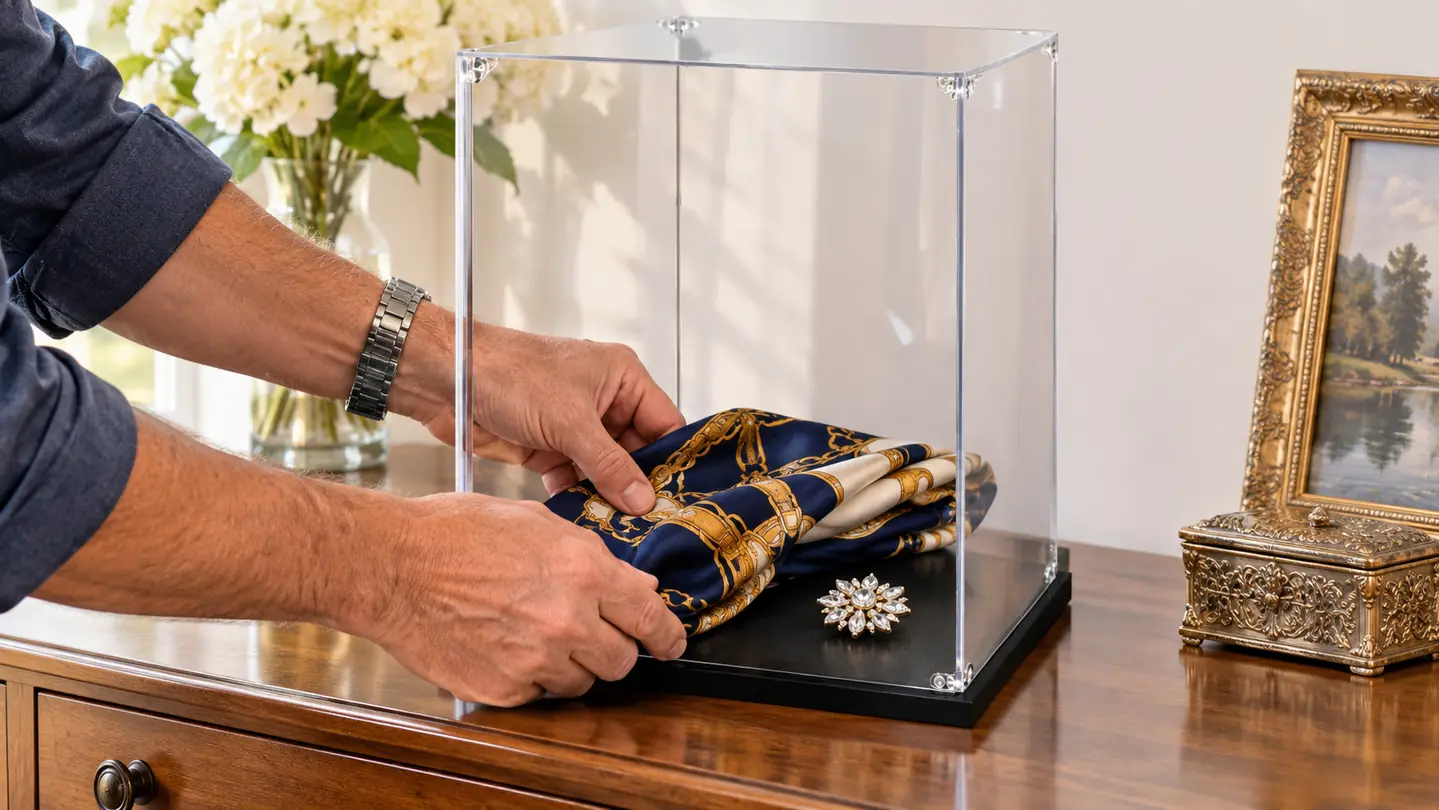
The second win is concentration. A small case forces me to choose. I put my grandmother's brooch, two clip earrings, and a small keepsake box in the KOLIPI case and leave the rest in the jewelry box. That sounds like a limitation, and it is, but it also means the pieces I love most are not lost in a crowd. The listing shows a 4.1 rating across 1,552 reviews. That is not a perfect score, and I would not pretend it is. But it is a real number from real buyers.
Where a Glass Curio Cabinet Wins
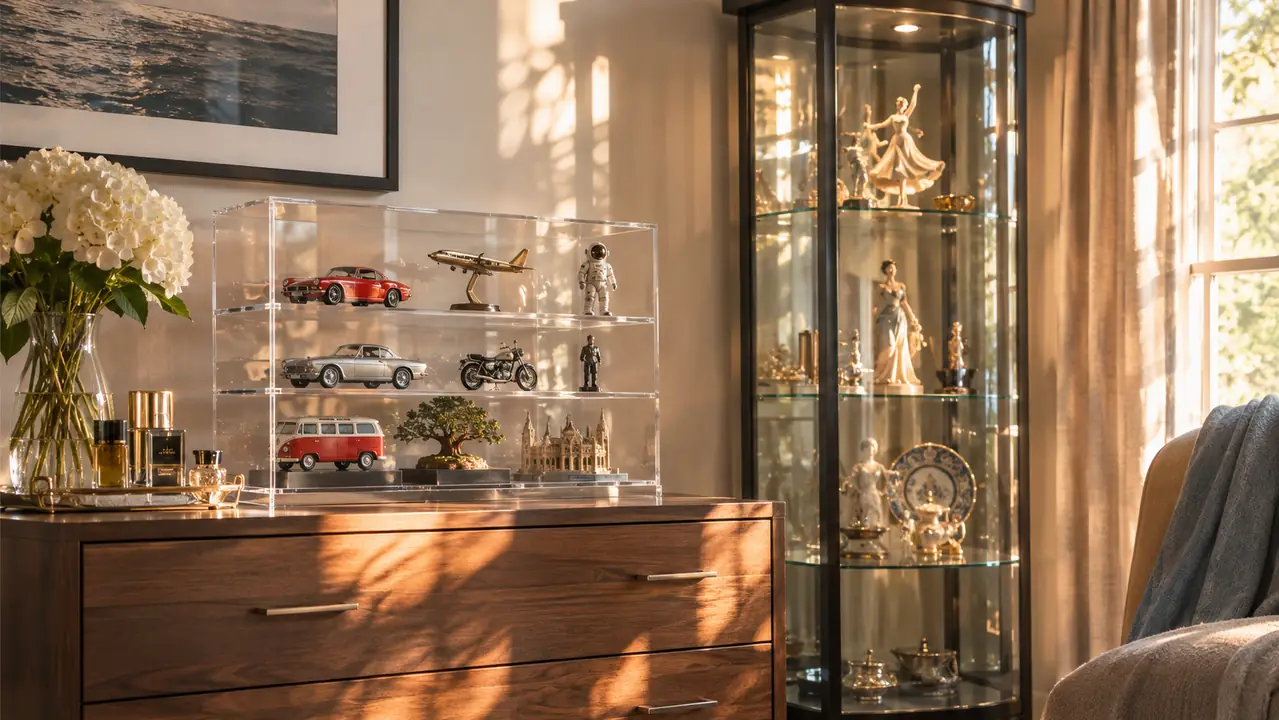
The glass curio cabinet wins on volume. It has shelves, it stands on the floor, and it can hold a whole season of handbags or a row of figurines without crowding. When Becca visits from Tampa and brings back a bag she borrowed, the cabinet has a place for it. The KOLIPI case does not. It holds a small group, and then it is full.
It also wins on presence. A glass cabinet changes a room. It gives the collection a home that looks intentional, not like a case I set on the dresser because I ran out of shelf space. If your spare room is already a display room and you want the collection to be the first thing people see, the glass cabinet does that better.
If You Have One Dresser Top and a Small Collection, Start Here
The KOLIPI acrylic display case is 8 by 8 by 12 inches and weighs 0.98 kg. It sits on a tabletop, so you do not need to clear a wall. Check the current listing for the assembly guide and the online install video.
Amazon Check Today's Price on Amazon →How I Compared Them in My Dressing Room
I did not compare them side by side in a showroom. I compared them the way I use them. I put the KOLIPI case on the dresser for a month and kept my daily brooches and one folded scarf in it. I used the glass cabinet for the pieces I do not wear every week: the handbags, the figurines, the keepsake boxes. I asked my Thursday lunch friends what they use for their own collections. One has a glass cabinet in her dining room. One uses a stack of acrylic boxes in a closet. The split was the same as mine: small and close versus large and formal.
The friend with the dining room cabinet told me something I have thought about since. She bought it before she had enough to fill it, and for two years it held four figurines and a lot of empty glass. She said it made the room feel unfinished, and she stopped noticing it after a while, which is the opposite of what a display piece is supposed to do. I had been close to doing the same thing with a cabinet I saw at an outlet mall in Brandon. Hearing her say it out loud saved me a truck rental and a Saturday.
The other thing I noticed is that the two pieces solve different problems. The KOLIPI case solves the problem of a small collection with no dedicated surface. The glass cabinet solves the problem of a collection that has outgrown the dresser. If you buy the small case expecting it to hold everything, you will be disappointed. If you buy the glass cabinet for six brooches, you will spend a lot of floor space on a small job.
What Fits in 8 by 8 by 12 Inches
The inside is 8 inches wide, 8 inches deep, and 12 inches tall. That is enough for a folded silk scarf, a small handbag, a row of brooches on a tray, or a shelf of figurines. It is not enough for a large handbag collection or a full set of dinnerware. I measured my own dresser first, with Walt's tape measure, on a Saturday morning after I had already moved the lamp twice. The dresser is 60 inches long. The case fits between the jewelry box and the lamp with about an inch to spare, which sounds tight until you remember that a case you can see through does not need elbow room the way a stack of boxes does.
I also learned to group by height. The 12 inch height means a small figurine can stand up, but a tall vase cannot. A folded scarf sits low, so I put it in the back and use the front for the brooches I reach for most. The listing says it is a display case for collectibles, and that is accurate. It is not a storage trunk. It is a case for the pieces you want to see.
The Assembly Question
The KOLIPI case comes with a user manual, and the listing points to online install videos. I needed both. The frame is acrylic, and the case is not a single molded piece. You put it together. When I did it, I used the dining table, laid a towel down first so the acrylic would not scratch, and set the pieces out in the order the manual showed. Start to finish it was under half an hour, and twenty minutes of that was me reading the instruction sheet twice. The online video helped more than the paper did. If you have assembled a bookshelf from a flat box, you will not find this hard.
My first attempt was crooked because I tightened one side before the others. My second attempt was fine. If you hate assembly, this is a real drawback, and it belongs in the con column. The glass cabinet is not automatically easier, either. A large cabinet has to come through a door, and it has to be leveled. I am not going to pretend that a glass curio cabinet arrives with no work. The difference is that the KOLIPI case is small enough to assemble on the dining table and carry back to the dresser by myself. That is the part I care about at 64. I do not want to wait for Walt to be in the mood to move furniture.
The KOLIPI case does not try to be furniture. That is exactly why it fits on my dresser.
Dust, Sunlight, and Daily Use
A case with sides keeps dust off the pieces I wear most. My brooches used to sit on an open tray, and I was dusting them every week. In the KOLIPI case, I dust the outside and leave the inside alone. The glass cabinet does the same job, but it has more shelves and more seams, so it takes longer to wipe down. Neither one is a sealed museum case. If you live on a busy street or you keep the windows open, you will still clean them.
Central Florida pollen is its own thing. In March and April the lanai screens turn yellow, and so does everything within a few feet of a window. When that happened this year, I wiped the outside of the case with a damp cloth and the brooches inside were untouched. That was the first week I stopped missing the open tray. Sunlight is the other issue. Acrylic and glass both let light through. I moved my dresser away from the afternoon sun years ago because the scarves were fading. If you have a bright window, put either case on the side of the room that gets indirect light. The KOLIPI case is small enough to move if you get it wrong. The glass cabinet is not. That is a practical advantage for the small case, and I would count it.
The Mistake I Nearly Made With the Small Case
I almost bought two small cases because I thought one would not hold enough. That would have been a mistake for my dresser. Two cases would have taken the space of the lamp, and I would have been back to a crowded surface. The KOLIPI case is 8 inches wide, so two side by side is 16 inches. On my dresser, that is the difference between a clear path to the jewelry box and a shuffle.
The better move was to edit. I moved the pieces I do not wear to the glass cabinet and kept the daily brooches in the KOLIPI case. If you are on the fence, start with one case and see what you actually reach for. The case is small enough that you can change your mind without redesigning the room.
What I Would Not Put in Either Case
I would not put anything valuable and loose in the KOLIPI case without a tray. Small earrings can slide when you move the case. I use a shallow dish inside for the clip earrings. That is not a product flaw. It is how I keep the case from becoming a jumble.
I would not put a heavy handbag on a glass cabinet shelf without checking the shelf. And I would not put either case in a damp garage or a hot attic. Acrylic and glass are not the issue. The pieces inside are. If the room gets humid, the scarf and the leather will suffer before the case does.
Who Should Buy Which
Buy the KOLIPI acrylic display case if you have a small group of pieces, a dresser top or shelf, and no room for furniture. It suits brooches, clip earrings, a folded scarf, small figurines, and keepsake boxes. It also suits a rental or a spare bedroom where you do not want to anchor a heavy piece to the wall. It is the case I would recommend to one of my Thursday lunch friends who wants her grandmother's brooches out where she can see them, not buried in a drawer.
Buy the glass curio cabinet if you have a collection that needs shelves, if you have floor space, and if you want the collection to be part of the room. It suits handbags, larger figurines, and pieces you rotate by season. It is also the better choice if you have family pieces that will grow. The KOLIPI case is not a starter cabinet. It is a small case for a small group. That is not a criticism. It is the job it was made for.
The Small Case That Earns Its Place on the Dresser
If your collection is six brooches and a scarf, not a wall of handbags, the KOLIPI acrylic display case is the simpler answer. It measures 8 by 8 by 12 inches and sits on a tabletop. Check the current listing for details.
Amazon Check Today's Price on Amazon →