
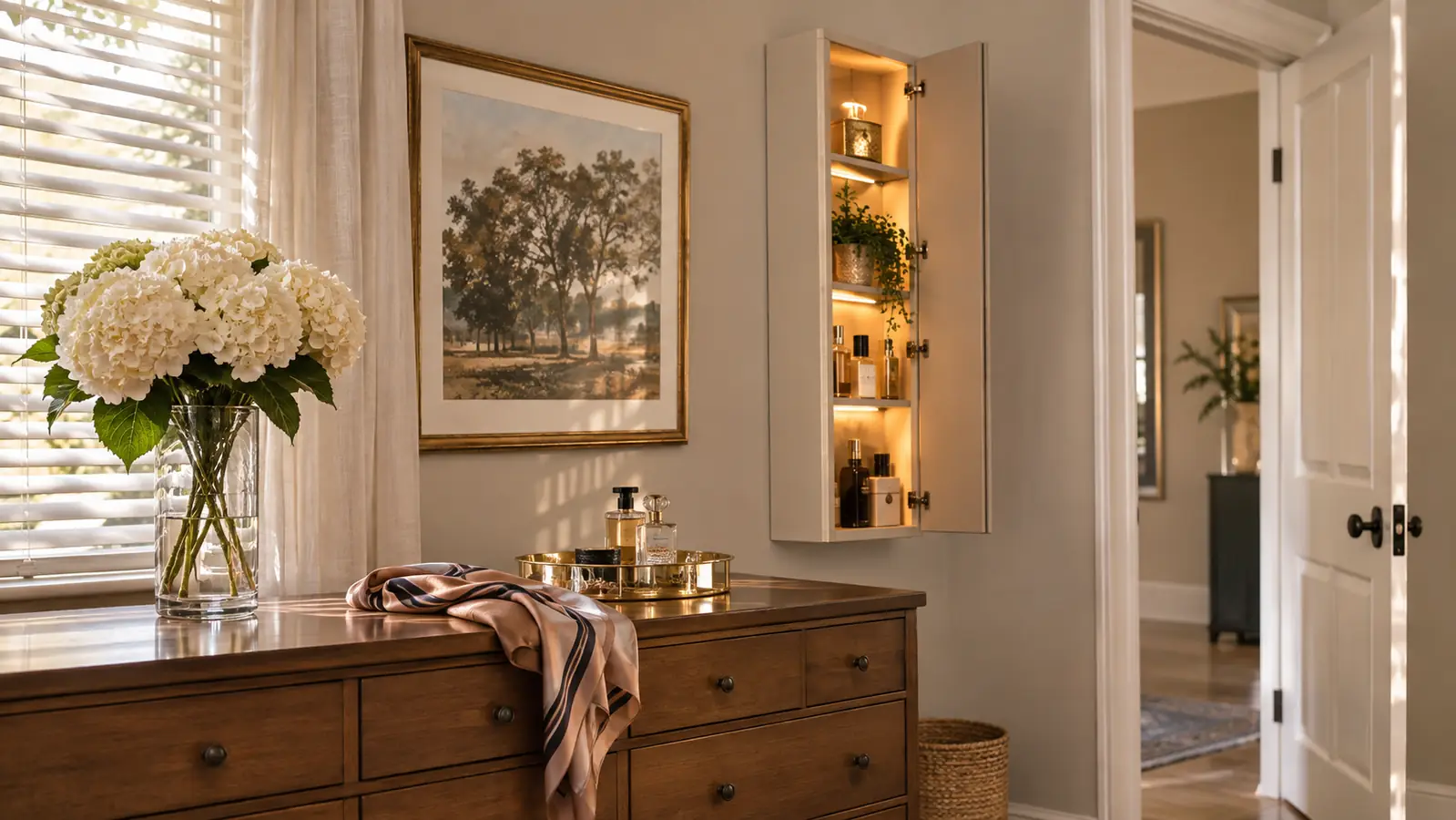
For about eleven years my costume jewelry lived in three places at once. A Christmas cookie tin on the dresser, a tangle at the bottom of whichever handbag I carried last, and a small pile beside the bathroom sink that I kept meaning to deal with. Every brooch I owned needed a search party. I would stand there at seven in the morning with one clip earring on, digging through a nest of chains for the mate, and by the time I found it I was out of patience and running late for lunch with the girls.
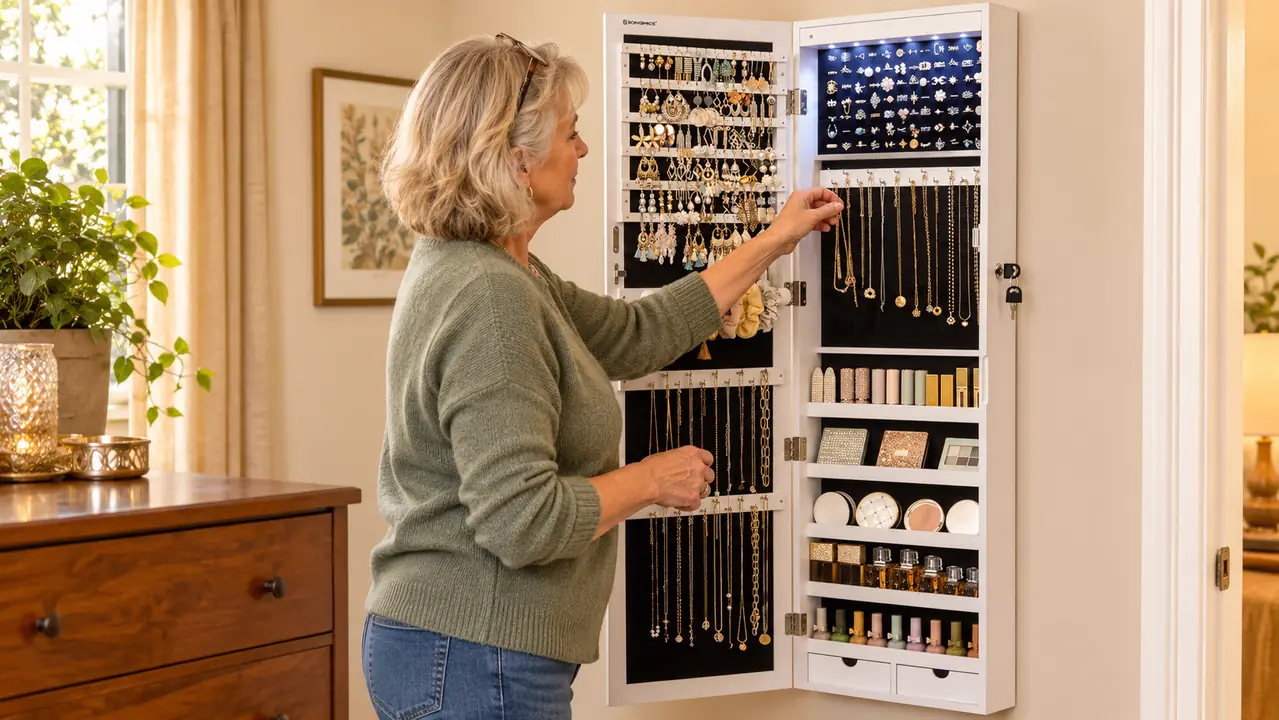
What fixed it was not a bigger box. It was getting the jewelry off the dresser and onto the wall where I could see all of it at once. I ended up with the SONGMICS 6 LED Mirror Jewelry Cabinet, the 47.2 inch tall one that mounts on a wall or hangs over a door, and the change was mostly about sight lines. When you can see everything, you stop buying a third pair of gold hoops because you forgot you already owned two. Below is how I would set up a SONGMICS cabinet from scratch if I had to do it again tomorrow, including the parts that took me two tries and one argument with Walt.
One of my Thursday lunch friends asked why I did not simply buy a bigger jewelry box. Fair question, and I have thought about it since. A bigger box still sits on the dresser and still has a lid you have to lift, and everything inside slides into a jumble at the bottom the moment you close it. A wall cabinet opens like a book and shows you the whole collection in one look, which is the entire difference between hunting and choosing. That is what I was after.
The Part That Actually Fixed My Mornings
A 47.2 inch cabinet that mounts on the wall or hangs over a door, made for necklaces, earrings, rings, bracelets and bangles. Two drawers, seven compartments, six lights inside that come on when you open it, and a key lock if you have a borrower in the family.
Amazon Check Today's Price on Amazon →Five Steps That Actually Stuck
Step 1: Empty Everything Out Before You Mount Anything
This is the step I skipped the first time and regretted. Take every piece out of the tin, the handbag, the dish on the sink and the little envelope in the nightstand, and put it all on one flat surface with a towel underneath. Then sort into four piles: wear it now, wear it once a year, needs a repair, and give it to Becca. My daughter lives in Tampa and has been quietly removing things from this house for twenty years, so that last pile is never empty. Sorting first also tells you how much cabinet you actually need, which is the number the box cannot tell you.
Test every clip earring while it is in your hand. Clip it onto your fingertip and give it a small tug. The ones that let go are the ones that have been falling off your ear in parking lots for years, and no cabinet, SONGMICS or otherwise, will fix a tired spring. I set aside nine pairs for repair and gave away fourteen, and I have not missed a single one of them. Walt asked twice whether I was sure. I was sure.
Be honest about the wear it once a year pile too. If a brooch has not been on your coat since before the pandemic, it is not going to start now. I moved those into a small keepsake box in the closet, which freed up more room in the cabinet than I expected for the pieces I actually reach for on a Tuesday. The goal is a cabinet you open every single day, not an archive with a mirror on the front.
Step 2: Measure the Wall and the Door Before You Choose a Spot
The cabinet is 47.2 inches tall, 14.6 inches wide and 3.9 inches deep, and it weighs 20.5 pounds before you put a single bracelet in it. Those numbers decide where it goes, not the other way around. In my spare bedroom I had exactly one stretch of blank wall between the closet and the dresser that would take a 47 inch box without crowding the light switch or blocking the mirror over the dresser. I measured it three times because I did not trust the first two answers.
The depth is the number people forget. Just under four inches off the wall means you can hang a cabinet like this over a door and still close the door, but you need to check the gap at the top of the door and the trim around the frame. Walt held ours up while I opened and closed the door about six times. It is a two person job and I will not try to talk you out of asking for help. The box includes two hanging hooks for door mounting and the hardware for wall mounting, plus an accessory kit and instructions.
Read the instructions. I know. I did not, and I put the first set of screws in a spot where the door would have swung straight into the dresser, which meant patching two holes and starting over on a Sunday afternoon with a mug of tea going cold on the windowsill. Twenty minutes of reading would have saved me an hour of spackle and a fair amount of pride.
Step 3: Mount It at Eye Level, Then Actually Test the Door
The right height is the one where you can see the back of your own ear without standing on tiptoe. For me at five foot four that put the bottom of the cabinet around hip height, with the mirror up at the top where it belongs. If you share the house with someone taller, mount it for the person who uses it most, which in this house is me and everyone knows it.
Then test the door swing with the cabinet loaded, not empty. Weight changes how a door hangs, and a cabinet that has swallowed a hundred pieces of jewelry behaves differently from one holding a lone bracelet. This is also the point where you find out whether your chosen spot was really clear, or whether you were simply hopeful at the hardware store.
The inside lights are the part I did not expect to like. There are six LEDs in there, and they come on by themselves when you open the door, so at seven in the morning I am not holding a chain up to a lamp trying to tell gold from brass. Soft light, nothing to switch on, nothing to remember. It sounds like a small thing and it is not.
The cabinet is 47.2 inches tall and 3.9 inches deep, which means an entire jewelry collection now lives in the depth of a paperback.
The lock is a key lock, and I want to be straight with you about it. It is a deterrent, not a vault. It keeps a visiting friend from trying on the good brooches and it gives me somewhere to put the pieces I would be sick about losing. It will not stop anyone determined. The key is small, so pick a spot for it right then and there, or you will be the one who cannot get into her own jewelry.
Step 4: Give Each Kind of Piece a Home and Leave It There
Inside you get seven compartments and two drawers, and the listing says it is meant for necklaces, earrings, rings, bracelets and bangles. Mine holds all of that plus about thirty brooches. The trick is to assign by category once and then stop reorganizing every time you read a magazine article about it. I reorganized twice in the first month and both times I moved my everyday pieces somewhere less convenient, which is how you end up back at the cookie tin.
Put the pieces you wear weekly at eye level and the once a year pieces high or low. That one rule did more for my mornings than anything else on this list. My everyday hoops and two favorite brooches sit right where my hand goes without thinking. The holiday pieces are up top and I have to reach for them, which is exactly right.
The two drawers took me a while to figure out. I tried using them for the things I wear most and it drove me mad, because opening a drawer while the door is already open is one motion too many before coffee. Now the drawers hold the larger brooches and the pieces I wear least. My scarves never went in here at all and they should not. Silk needs room to breathe and the SONGMICS cabinet is for jewelry, not textiles.
One thing nobody tells you: leave a little empty space. A cabinet packed to the last inch is a cabinet you stop putting things back into, because sliding a bracelet into a crowd is more work than dropping it on the dresser. I keep the bottom compartment about a third empty on purpose and it has stayed tidy for two years.
Step 5: Put a Five Minute Reset on the Calendar
Any storage system falls apart in small increments. You come home tired, you drop the earrings on the dresser, and by Friday there is a small colony of jewelry on top of the cabinet instead of inside it. I do a reset on Sunday morning with my coffee. Five minutes, everything back where it belongs, and a quick look for anything that needs a new back or a bent pin before it disappears into a drawer forever.
Two other habits saved me. First, the key lives on a small hook inside the closet door, not loose in a drawer, so it is never lost. Second, Becca and I have a standing rule. She borrows, she tells me, and it goes back in the cabinet before she drives home to Tampa. That rule has held for two years, which is longer than any other rule in this family.
Wipe the inside with a dry cloth once a month while the door is open. Costume jewelry tarnishes faster than people expect in Florida humidity, and a dry cloth plus keeping pieces off the dresser where the ceiling fan moves dust around has made a real difference to my brass.
What Else Helps
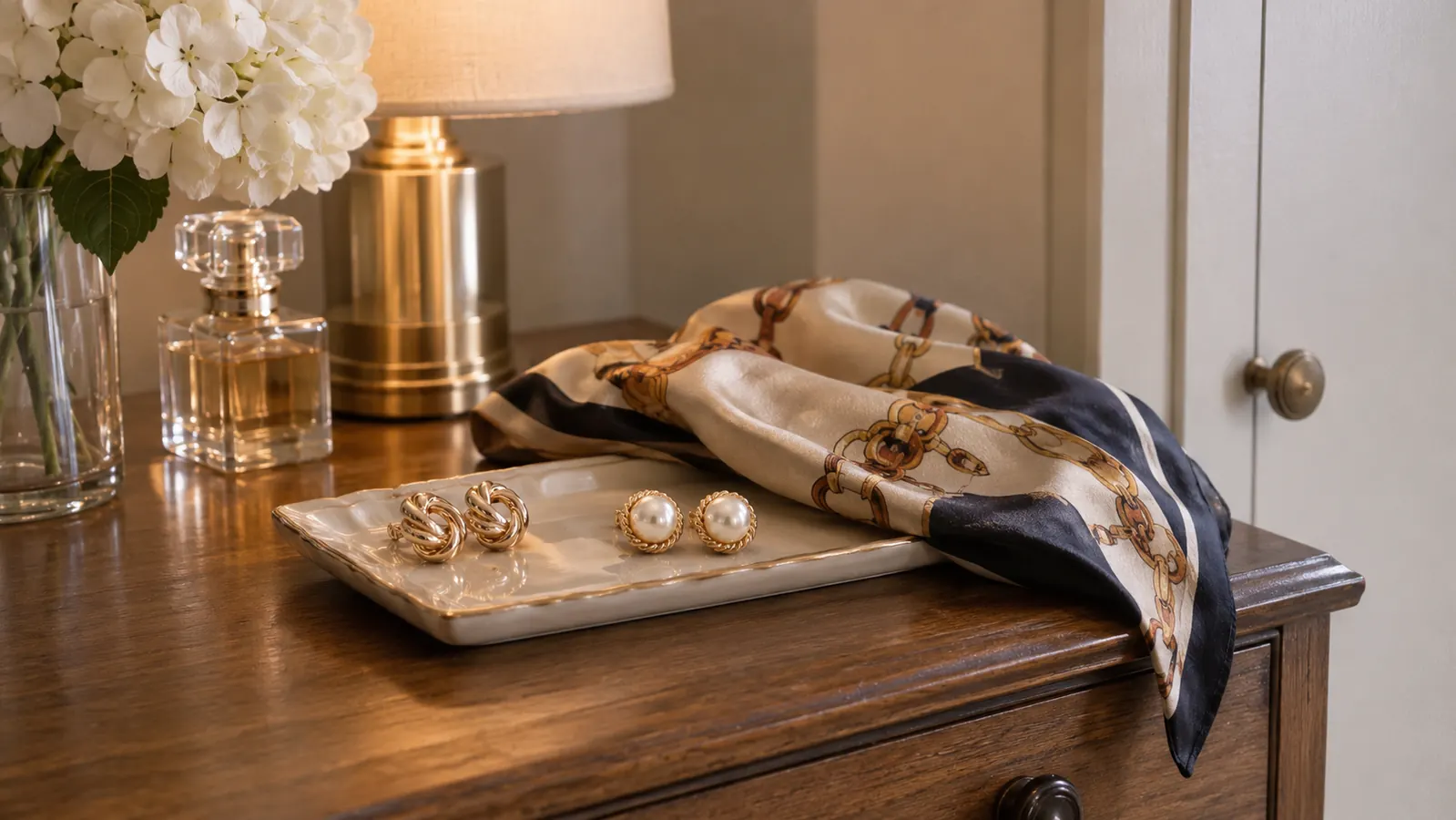
A small tray on the dresser for the pieces you take off at night. This sounds like defeat, but it is not. It gives the two or three things you wore that day somewhere to land that is not the cabinet door or the carpet, and on Sunday you carry the tray over and put everything away in one trip.
Good light in the room matters as much as the lights inside the cabinet. I put a lamp on the dresser because the ceiling fixture in that spare bedroom is honestly terrible, and being able to tell silver plate from sterling before you walk out the door is worth the trouble of finding an outlet.
Keep a small envelope taped inside the closet door for the broken things. One earring back, a bent pin, a chain with a jump ring that opened. When the envelope has four or five items in it, take it to the jeweler once instead of making four separate trips across town.
A soft pouch for travel is the last thing I added. When I go to Becca's for a weekend I used to tip three pieces into my handbag and spend Saturday untangling them. Now they go into a pouch, the pouch goes into the bag, and nothing in the bag eats anything else. It costs almost nothing and it solved a problem I had stopped noticing.
And if you are weighing the SONGMICS cabinet against a jewelry box that sits on the dresser, that is a fair question and I have opinions about it. A box is easier to move and easier to hide. A wall cabinet shows you everything at once and takes nothing off your dresser surface. My dresser now has a lamp, a tray and a photograph of Walt on it, and I would not go back to the tin.
If Your Jewelry Lives in a Cookie Tin, Start Here
47.2 inches tall, wall mounted or over the door, six lights that come on when you open it, two drawers and seven compartments. It took one afternoon and one argument with my husband to hang. The mornings got quieter after that.
Amazon Check Today's Price on Amazon →